Wednesday, November 30, 2005

If You Let The Lunatics Run The Institution...

...you get lists like these:

Snoop's List

That's right - Stephen "Balloon Cup" Glenn, the mastermind behind The One Hundred, put together his own personal top 100 list. Makes for some fun reading - but, dude, cool it with the abstracts! Sheesh.

I'll follow up tomorrow by posting my Top 100 here over 10 or so days - not because I'm really wanting to build suspense, but because it's a lot easier to get everything posted in bite-sized pieces. Needless to say, Poker will not be #1. :-)

Monday, November 21, 2005

The One Hundred Vs The Gaming Awards

Well, at least, the semi-respected gaming wards. :-)

This information was originally published on the spielfrieks mailing list by Morgan Dontanville, and given a small correction by Larry "My Ex-GG Roomie" Levy.

Deutscher Spiele Preis
The "German Game Prize" is often held up as the 'gold standard' of Eurogaming awards - as it is voted on by gamers for gamers. Of the 16 times this has been awarded, 12 of those games appeared on The One Hundred.
  • Adel Verpflichtet
  • Modern Art
  • 6 Nimmt
  • Settlers of Catan
  • El Grande
  • Lowenhurz
  • Tigris and Euphrates
  • Tikal
  • Taj Mahal
  • Carcassonne
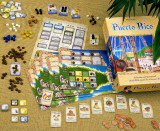
  • Puerto Rico
  • St Petersburg
The missing games that were awarded the DSP are:
  • Master Labyrinth
  • Der Fliegende Holländer
  • Amun-Re
  • Louis XIV (which was not released when The One Hundred was voted on)
Spiel des Jares
The "German Game of the Year" award is credited with turning around the German gaming industry. It's not always as popular with hardcore gamers, due to the family-oriented nature of the picks. Of the 27 times the SdJ has been awarded, 11 of those games appeared on The One Hundred.
  • Hare & Tortoise
  • Adel Verpflichtet
  • Um Reifenbreite
  • Liar's Dice
  • Settlers of Catan
  • El Grande
  • Elfenland
  • Tikal
  • Torres
  • Carcassonne
  • Ticket To Ride
None of the SdJ winners from the 80's made the list (including Scotland Yard and Heimlich &Co.). Beginning with 1990, the missing games:
  • Drunter & Drüber
  • Manhattan
  • Mississippi Queen
  • Villa Paletti
  • Alhambra
  • Niagara (which was not released when The One Hundred was voted on)
International Gamers Award
The most recent gaming award is voted on by a jury of international gamers and shows a marked preference for gamer-y games. The multiplayer game award has been given 7 times... 6 of those games appear on The ONe Hundred:
  • Tikal
  • Princes of Florence
  • San Marco
  • Puerto Rico
  • St Petersburg
  • Age of Steam
The one missing game is Ticket To Ride: Europe, which was released after The One Hundred was voted on.

All six of the two-player IGA award games made the list:
  • Lost Cities
  • Battle Cry
  • Dvonn
  • LOTR: The Confrontation
  • Memoir '44
  • War of the Ring

The Ones That Got Away: John Palaygi

Keythedral
Clean, elegant, simple and fast.

Keywood
This is an awful high placement for such a small distribution game but it's well worth it. It's a hard, viscious game(at least the way our group plays it) that I really enjoy.

Hamster Rolle
My dexterity/party game entry all rolled into one! Always a blast to play and sure to attract anyone that's not seen it before.

Sherlock Holmes, Consulting Detective
A deduction gameyou can play solo (actually the only way to play this one in my book). Though if you've got a good memory replay value is nil.

Trivial Pursuit
I don't care what anyone else says. I like Trivial Pursuit (especially the early editions, before the "pop culture" questions took over). I never fail to learn something and am always surprised at what I do know.

The Ones That Got Away: W. Eric Martin

Familienbande

Maybe an odd choice for my favorite game of all time, but I've played 60+ times and still have fun. The theme meshes so well with the gameplay-- kill that bloodline; like mother, like son; and so forth -- that new players really get into the game. Also, my wife really enjoys the game, which is always a plus.

Piratenbilliards

One of the most addictive games ever. I bought an American version of Piratenbilliards from an online toy company, gave two away as gifts, and ordered seven more copies for folks who wanted one of their own after playing mine. Even my parents bought a copy!

Fluxx

A guilty pleasure, and one I can share only with my brother due to general loathing of this game from the game community. We play best 3 out of 5 or 4 out of 7, and because we know the cards so well, we whip through these games in ten minutes or so. Sure, Fluxx is light and chaotic, but it's hardly mindless, as many critics contend.

I'm sure my choices would differ today after another year of gaming experience, but this list was a good picture of that time.

The Ones That Got Away: Michael Weston

Confusion

No, it won't make the Top 100, but I still think it's the coolest game out there. Especially since a friend made me a home-made set and I don't have to rely on Frank B. or Craig B. to bring a copy.

Way too obscure for any chance, on top of being a niche game itself. Most people aren't willing to tax the logic corner of their brain enough for this beauty. Other than being an avowed deduction game freak, I appreciate that this game isn't actually won just by deducing the answers. Deduction is just a tool to get you to a point where you think you can win the actual soccer-like movement on the board.

Meuterer

A very underrated game just because it's hard to learn from the rules.

Not sure why more people don't like this one. It packs a lot of game into a very little box. Sure the mechanisms are about as non-intuitive as it gets, but beyond that is a very entertaining game of second guessing and smart hand management. Definitely my favorite of the "secretly choose a role" games out there.

Sleuth

The finest example of a pure deduction game.

Having since played Larry Levy's "Deduce or Die", Sleuth is no longer my favorite for those rare times when I can get fellow deduction nuts together. Still a great game that deserves more table time. Still, it was great to see one deduction game make it on the list.

Das Motorsportspiel

Yeah, another dark horse. You know the timer is set for the right limit when you can feel the adrenaline rushing as you have to rush to get your move done in time.

Never had a chance, but still the best racing game out there. Unlike Formula De and all the other race games that have been done, this is the only one to really feel like a race. The consolation prize is that at least Formula De DIDN'T make the list either.

Klunker

There's more here than most people give it credit for. For such a simple set collection game, there's a lot of subtlety.

I'm sure Dave Vander Ark listed this one too, but we may be the only ones. Repeated plays just continue to show that smart play can mitigate the luck of the draw, at least to the same extent as any other card-based game we typically play. Not a Top 10 game by any stretch, but I think it's at least as good as anything in the bottom 25.

The Ones That Got Away: Kevin Whitmore

Waldschattenspiel

There is something magical about this game. I am sure most strategy game fans will sneer at this selection. For me,Waldschattenspiel bypasses the brain and hits me directly in the heart. Play it at midnight with a bunch of friends in a camphouse in the middle of the New Mexico forest - and I guarantee you will also come to love this game.

Carcassonne: The City

It has become all too chic to dismiss anything with Carcassonne in the title. I think a great number of people have never given this extremely interesting strategy game a chance. An added bonus is the very cool city you have built once the game is completed.

Entdecker

It never really had a chance, but this game remains a personal favorite of mine. I'll be curious to see what Rev. Jackson has to say about it.

The Ones That Got Away: Brian Leet

Fast Food Franchise

Always a blast with gamers and non-gamers alike. Has the good habit of usually ending right when the outcome becomes obvious to the players.

This game hasn't been in print for nearly a decade, so I'm not surprised that it didn't make the list. I also am sure that the similarities to Monopoly probably turn off some players. For me, the similarities are enough to entice casual gamers (who don't feel like they need to learn a whole new game), while turning out to be entirely superficial from a game play standpoint. While there is a fair amount of luck here there is also strategy and planning as well as calculated risk. I would love to see a reprint of this title so it could get wider availability (and better components).

American Megafauna

I enjoy 'experience' games (games where the experience of playing is more important than your score) and this is my favorite of the bunch. The only downside here is finding players.

I wouldn't be shocked if I am the only player who nominated this game. I would be very shocked if there was more than one other person who also listed it. In many ways the game is a lot of things I don't care for. It is fiddly, complex, long, filled with obscure or odd rules interactions, and careful strategy is often overturned by pure dumb luck. With all that said, the theme and scientific accuracy (dare I say simulation?) are what win me over with this one. I find it fascinating, always enjoy the experience of the play, and can honestly say I've learned more from the game than any other since I was rather young. Still, it remains a personal affectation, and is a game I would recommend to only certain of my friends.

The Ones That Got Away: Frank Hamrick

The Bridges of Shangri-La

Yes, it's a bit dry, and a bit abstract. But I love the turn angst and the many, many quandary's each turn presents. You need to place your markers in a dozen places each turn. I also love the little wooden bridges and the awesome looking board at game's end. The only thing that keeps this one out of my top five - I can get very few people to play it with me. Otherwise, I would put this up with the top 3! (I realize I'm in a tiny minority here).

A Game of Thrones

At the time I voted, this one was hot with my group. At the time we felt it was the best "German style" wargame out there (I know it isn't a "German" game). However, it has slid back several notches since I voted for a number of reasons - the starting positions are a bit unbalanced, and it is too complicated to explain quickly or to appeal to my non-gaming friends and family. But for 6 blood-thirsty gamers, who have the time, this one (and its CoK expansion) is very good if you want a lighter war-game.

Boomtown

What was I thinking!! One of the 15 best games I own!? I put it 15th on my list because I had just gotten it and had played about 3 times - so it was still new, fresh, exciting. It's still fun, good. But it certainly isn't in the all-time "great" category. Anyway, here's what I wrote back then...

For pure fun, this one is great. It may make my top 15 because it is new, but we were all surprised at how interesting this one was. Lots of fun to play (the theme helps), great looking cards (terrific matte finish and feel) and wooden "mayors." Mechanics are simple. It is basically a bidding game with a few nice twists. Some aggression creates a bit of turn angst (players vie for control of various towns - Cactus Junction; Cold Mountain; Coyote City; Dry Gulch; and San Narciso). Lighter game that hits the spot for me. Only negative - some of the art of almost nude girls on a few of the cards. Totally unnecessary.

The Ones That Got Away: Mark Jackson

This post (and a number that follow it) are entries by those who helped vote for The One Hundred, lamenting "the ones that got away" - in other words, those games they voted for that didn't make the cut. Their statements from the period of voting (late 2004) are in italics; more recents thoughts are in regular print.

Entdecker (older version)
Supposedly a part of the original monster prototype that birthed Settlers & Lowenherz, Entdecker has always received less admiration than it's brothers. Which, frankly, is a crying shame, as it's a fast-moving game of exploration with gorgeous production and simple game play. I play using the Manu variants (for slightly more gamer friendliness)... but I've recently found that the published rules work great with my 4 & a half year old son.

And don't get me started about the hack job Teuber did to his own game with the second release of Entdecker... he took a clean, simple yet not simplistic 30-60 minute exploration game and turned it into an unnecessarily messy 75-120 minute game with less exploration (what's with the goal mountains?) and a twinky hut/scout system that actually adds MORE luck to the game. I still can't understand why people think this is the more gamer-y of the two versions, except that it's more complicated!

Fast Food Franchise
Tom Lehmann took the basic mechanisms of Monopoly (roll'n'move, own properties that people land on and pay rent, chance cards that affect the game, and so on) and grafted on others (the "map" of the USA in the middle of the board, advertising, the asymetrical nature of the different companies) to create a minor masterpiece. Loved by gamers & non-gamers alike, Fast Food Franchise is worth tracking down.

Friday, November 18, 2005

How Big A Geek R U?

In other words, what's your The One Hundred "score"? Check out The Whole Enchilada and then do a itty bitty bit of math.

The One Hundred Score = # of these games you've played + # of these games you own

Fluff Daddy's "score" is:
  • 151 (87 played, 64 owned)
The games I haven't played are:
  • Age of Steam (probably should try this, but as I've said other places, having trouble washing the bad taste of Volldampf out of my mouth)
  • Breaking Away (sounds math-y)
  • Bridge (unwilling to invest the time to learn)
  • Die Macher (I've played one round... but not a whole game)
  • Domaine (I'm such a big fan of Lowenherz that I cringe at revising it - and I hated what Teuber did to Entdecker in the second go-around)
  • Gipf (as much as I like Dvonn & Zertz, I need to try this one)
  • Go (Pente hurts my head...)
  • Goa (interested in trying this one, actually)
  • Mu & Mehr (I've played one of the memory games, but not Mu)
  • Roads & Boats (it's mostly a time thing - that, and a "nobody nearby owns a copy" thing)
  • Titan (I still remember looking at it longingly in the store way back when - "monster slugathon? cool!", but I never broke down & bought it... and now, 20+ years later, I haven't played it, either)
  • War of the Ring (the guy who owned this in my group traded it away before we could try it... as he has done with numerous games!... hi, John!)
  • Was Sticht? (watched it played at a Gulf Games, and I could smell the brain-buring action from across the room - ouch.)

We're Numero Uno

Here's a list of the games that received 1st place votes from the participants. (It's important to note that no games made it onto The One Hundred with only a single voter.)

Six Votes

  • Euphrat & Tigris

Five Votes

  • Puerto Rico

Four Votes

  • Tichu

Three Votes

  • Cosmic Encounter
  • El Grande
  • Taj Mahal

Two Votes

  • 1830
  • Acquire
  • Bridge
  • Die Macher
  • Fresh Fish
  • Go
  • Ra
  • Settlers of Catan

One Vote

  • Age of Renaissance
  • Bohnanza
  • Can't Stop
  • Crokinole
  • Diplomacy
  • Dune
  • Expedition/Wildlife Adventure
  • Flaschenteufel
  • Goa
  • History of the World
  • Liar's DiceMedici
  • Power Grid
  • Princes of Florence
  • Saint Petersburg
  • Times Up
  • Torres
  • Union Pacific

The five highest rated games that received NO first place votes were:

  • Age of Steam
  • Lord of the Rings
  • Memoir '44
  • Mu & Mehr
  • Ticket to Ride

The following games received first place votes but didn't make The One Hundred:

  • 500
  • Aladdins Dragons
  • Confusion
  • De Bellis Mutitudinis
  • Duel of Ages
  • Familienbande
  • Medina

Through The Years

And, since I've got a spreadsheet "and I know how to use it" [Mark: "I'm a donkey on the edge!"], here's the The One Hundred broken down by year of publication. [Mark: Yes, I realize that some of these games, particularly the public domain games, don't have a definitive date of publication. In those cases, I did some research, considered my options, then picked a date that sounded good to me. Scientific, eh?] All other dates of publication are from Board Game Geek... note: the dates used are for the FIRST publishing of the game, even if it was less well-known (as in Crude/McMulit or Homas Tour/Um Reifenbreite).

3000 BC
  • Backgammon
1500 BC
  • Go
1810
  • Poker
1860
  • Bridge
1865
  • Crokinole
1937
  • Spades
1948
  • Scrabble
1959
  • Diplomacy
1962
  • Acquire
1974
  • Hare & Tortoise
  • Liar's Dice
  • McMulti
1977
  • Cosmic Encounter
1979
  • Dune
1980
  • Can't Stop
  • Titan
1981
  • Civilization
1982
  • Um Reifenbriete
1984
  • Wizard
1985
  • Expedition/Wildlife Adventure
1986
  • 1830
  • Code 777
  • Die Macher
1989
  • Ave Caesar
  • Taboo
1990
  • Adel Verpflichtet/Hoity Toity
  • Daytona 500
1991
  • Breaking Away
  • History of the World
  • Res Publica
  • Tichu
1992
  • Modern Art
1994
  • 6 Nimmt!
  • I'm The Boss/Kohle Kies & Knete
  • Quandary
  • RoboRally
  • Was Sticht?
1995
  • Carabande
  • El Grande
  • Flaschenteufel
  • Medici
  • Mu & Mehr
  • Settlers of Catan
1996
  • Age of Renaissance
  • Hannibal: Rome v. Carthage
1997
  • Bohnanza
  • Dr Jekyl & Mr Hyde
  • Euphrat & Tigris
  • For Sale
  • Fresh Fish
  • Lowenherz
  • Showmanager/Atlantic Star
1998
  • Basari
  • Elfenland
  • Gipf
  • MR1: Jack the Ripper
  • Samurai
  • Schnappchen Jagd
  • Through the Desert
1999
  • Battleline/Schotten Totten
  • Chinatown
  • Lost Cities
  • Mamma Mia
  • Ra
  • Ricochet Robot
  • Roads & Boats
  • Stephensons' Rocket
  • Tikal
  • Torres
  • Union Pacific
  • Vinci
2000
  • Battle Cry
  • Blokus
  • Carcassonne
  • Citadels
  • La Citta
  • Lord of the Rings
  • Princes of Florence
  • Taj Mahal
  • Time's Up
  • Traumfabrik
  • Web of Power
2001
  • Africa
  • Capitol
  • Dvonn
  • Power Grid/Funkenschlag
  • Royal Turf
  • San Marco
2002
  • Age of Steam
  • LOTR: The Confrontation
  • Puerto Rico
  • Wallenstein
2003
  • Attika
  • Domaine
  • Smarty Party
2004
  • Goa
  • Memoir '44
  • St Petersburg
  • Ticket To Ride
  • War of the Ring
I think what's really interesting grouping these games by years is that it allows me to see what was "in the works" at the time. Some highlights from the synapses firing in my brain:
  • 1999 was an amazing year - and I got in on the front end of it, thanks to Gulf Games 3 being timed perfectly so that Jay Tummelson flew in from Nuremberg with the first copies of 5 of the 12 games listed.
  • 2000 had ten games listed - when we talk about a "golden time" in gaming, was it 1999-2000?
  • Acquire is all the more amazing when you realize it was published in 1962.
  • What was going on in Germany in 1996? The only two listed games are Avalon Hill wargames. (Was everyone so busy playing Settlers that they took the year off?)

Thank These Guys

Thought y'all might be interested in some overall information about the designers & The One Hundred:

six of the games have no known designer:
  • Backgammon
  • Bridge
  • Crokinole
  • Go
  • Poker
  • Spades
Reiner Knizia designed seventeen of the games (wow!):
  • Africa
  • Battleline/Schotten Totten
  • Euphrat & Tigris
  • Lord of the Rings
  • Lost Cities
  • LOTR: The Confrontation
  • Medici
  • Modern Art
  • Quandary
  • Ra
  • Res Publica
  • Royal Turf
  • Samurai
  • Stephensons' Rocket
  • Taj Mahal
  • Through the Desert
  • Traumfabrik
Wolfgang Kramer designed seven of the games (by himself or with a partner):
  • 6 Nimmt!
  • Daytona 500 (w/Mike Gray)
  • El Grande (w/Richard Ulrich)
  • Expedition/Wildlife Adventure (w/Ursula Kramer)
  • Princes of Florence (w/Richard Ulrich)
  • Tikal
  • Torres (w/Michael Kiesling)

Alan Moon designed five of the games (by himself or with a partner):

  • Capitol (w/Aaron Weissblum)
  • Elfenland
  • San Marco (w/Aaron Weissblum)
  • Ticket To Ride
  • Union Pacific
Klaus Teuber designed four of the games:
  • Adel Verpflichtet/Hoity Toity
  • Domaine
  • Lowenherz
  • Settlers of Catan
Richard Borg designed three of the games:
  • Battle Cry
  • Liar's Dice/Call My Bluff
  • Memoir '44
Uwe Rosenberg designed three of the games:
  • Bohnanza
  • Mamma Mia
  • Schnappchen Jagd
Sid Sackson designed three of the games:
  • Acquire
  • Can't Stop
  • I'm The Boss/Kohle Kies & Knete
Aaron Weissblum designed three of the games (with partners):
  • Capitol (w/Alan Moon)
  • San Marco (w/Alan Moon)
  • Smarty Party (w/Pitt Crandlemire)
Kris Burm designed two of the games:
  • Dvonn
  • Gipf
The team of Eberle, Kittredge & Olotka designed two of the games:
  • Cosmic Encounter
  • Dune
Friedemann Friese designed two of the games:
  • Fresh Fish
  • Power Grid/Funkenschlag
Dirk Henn designed two of the games:
  • Showmanager/Atlantic Star
  • Wallenstein
Alex Randolph designed two of the games (by himself or with a partner):
  • Ricochet Robot
  • Code 777 (w/ Robert Abbott)
Karl-Heinz Schmiel designed two of the games:
  • Die Macher
  • Was Sticht?
Francis Tresham designed two of the games:
  • 1830
  • Civilization
Richard Ulrich designed two of the games (with a partner):
  • El Grande (w/Wolfgang Kramer)
  • Princes of Florence (w/Wolfgang Kramer)
And the rest of the games on The One Hundred - their designers only appeared once. Still, it's a nice crowd to be in when it includes such notables as Robert Abbott, Stefan Dorra, Rudiger Dorn, Jean du Poel, Bruno Faidutti, Mike Fitzgerald, Doris & Frank, Richard Garfield, Mike Gray, Philippe Keyaerts, Dave Parlett, Wolfgang Riedesser, Peter Sarrett, Michael Schacht, Andreas Seyfarth, Reinhard Staupe, Martin Wallce & Klaus-Jurgen Wrede.

Recap: #10-#1

#10: Tichu
  • designer: Urs Hostettler
  • date of publication: 1991
#9: Ra
  • designer: Reiner Knizia
  • date of publication: 1999
#8: Ticket To Ride
  • designer: Alan R Moon
  • date of publication: 2004
#7: Age of Steam

designer: Martin Wallace
date of publication: 2002

#6: Power Grid/Funkenschlag

designer: Friedemann Friese
date of publication: 2001

#5: Princes of Florence
  • designer: Wolfgang Kramer & Richard Ulrich
  • date of publication: 2000
#4: Settlers of Catan
  • designer: Klaus Teuber
  • date of publication: 1995
#3: El Grande
  • designer: Wolfgang Kramer & Richard Ulrich
  • date of publication: 1995
#2: Euphrat & Tigris
  • designer: Reiner Knizia
  • date of publication: 1997
#1: Puerto Rico
  • designer: Andreas Seyfarth
  • date of publication: 2002

Recap: #20-#11

#20: Mu & Mehr
  • designer: Doris Matthaus & Frank Nestel
  • date of publication: 1995
#19: Medici
  • designer: Reiner Knizia
  • date of publication: 1995
#18: Crokinole
  • designer: ?
  • date of publication: c. 1865
#17: Time's Up
  • designer: Peter Sarrett
  • date of publication: 2000
#16: Union Pacific
  • designer: Alan R Moon
  • date of publication: 1999
#15: St Petersburg
  • designer: Bernd Brunnhofer, Jay Tummelson, Michael Bruinsma
  • date of publication: 2004
#14: Cosmic Encounter
  • designer: Bill Eberle, Jack Kittredge, Peter Olotka
  • date of publication: 1977
#13: Bohnanza
  • designer: Uwe Rosenberg
  • date of publication: 1997
#12: Lord of the Rings
  • designer: Reiner Knizia
  • date of publication: 2000
#11: Acquire
  • designer: Sid Sackson
  • date of publication: 1962

Recap: #30-#21

#30: Modern Art
  • designer: Reiner Knizia
  • date of publication: 1992
#29: Battleline/Schotten Totten
  • designer: Reiner Knizia
  • date of publication: 1999
#28: Showmanager/Atlantic Star
  • designer: Dirk Henn
  • date of publication: 1997
#27: Liar's Dice/Call My Bluff
  • designer: Richard Borg
  • date of publication: 1974
#26: Civilization
  • designer: Francis Tresham
  • date of publication: 1981
#25: Lost Cities
  • designer: Reiner Knizia
  • date of publication: 1999
#24: La Citta
  • designer: Gerd Fenchel
  • date of publication: 2000
#23: Taj Mahal
  • designer: Reiner Knizia
  • date of publication: 2000
#22: Die Macher
  • designer: Karl-Heinz Schmiel
  • date of publication: 1986
#21: Memoir '44
  • designer: Richard Borg
  • date of publication: 2004

Recap: #40-#31

#40: Kohle Kies & Knete/I'm The Boss
  • designer: Sid Sackson
  • date of publication: 1994
#39: Tikal
  • designer: Wolfgang Kramer
  • date of publication: 1999
#38: Through the Desert
  • designer: Reiner Knizia
  • date of publication: 1998
#37: Roads & Boats
  • designer: Jeroen Doumen & Joris Wiersinga
  • date of publication: 1999
#36: Fresh Fish
  • designer: Friedemann Friese
  • date of publication: 1997
#35: Web of Power
  • designer: Michael Schacht
  • date of publication: 2000
#34: Expedition/Wildlife Adventure
  • designer: Wolfgang Kramer & Ursula Kramer
  • date of publication: 1985
#33: Torres
  • designer: Wolfgang Kramer & Michael Kiesling
  • date of publication: 1999
#32: RoboRally
  • designer: Richard Garfield
  • date of publication: 1994
#31: Carcassonne
  • designer: Klaus-Jurgen Wrede
  • date of publication: 2000

Recap: #50-#41

#50: Goa
  • designer: Rudiger Dorn
  • date of publication: 2004
#49: Poker
  • designer: ?
  • date of publication: c. 1810
#48: Adel Verpflichtet/Hoity Toity
  • designer: Klaus Teuber
  • date of publication: 1990
#47: Titan
  • designer: Jason B McAllister & David A Trampier
  • date of publication: 1980
#46: Attika
  • designer: Marcel-Andre Casasola Merkle
  • date of publication: 2003
#45: 1830
  • designer: Frances Tresham
  • date of publication: 1986
#44: Lowenherz
  • designer: Klaus Teuber
  • date of publication: 1997
#43: Traumfabrik
  • designer: Reiner Knizia
  • date of publication: 2000
#42: Bridge
  • designer: ?
  • date of publication: c. 1860
#41: For Sale
  • designer: Stefan Dorra
  • date of publication: 1997

Recap: #60-#51

#60: Blokus
  • designer: Bernard Tavitian
  • date of publication: 2000
#59: Hannibal: Rome v. Carthage
  • designer: Mark Simonitch
  • date of publication: 1996
#58: Wizard
  • designer: Ken Fisher
  • date of publication: 1984
#57: Schnappchen Jagd
  • designer: Uwe Rosenberg
  • date of publication: 1998
#56: Diplomacy
  • designer: Alan B Calhamer
  • date of publication: 1959
#55: Wallenstein
  • designer: Dirk Henn
  • date of publication: 2002
#54: Can't Stop
  • designer: Sid Sackson
  • date of publication: 1980
#53: Daytona 500
  • designer: Wolfgang Kramer & Michael Gray
  • date of publication: 1990
#52: Ricochet Robot
  • designer: Alex Randolph
  • date of publication: 1999
#51: Go
  • designer: ?
  • date of publication: c. 1500 BC (yes, I'm aware there isn't one date... I took the average)

Recap: #70-#61

#70: Scrabble
  • designer: Alfred Mosher Butts
  • date of publication: 1948
#69: Flaschenteufel
  • designer: Gunter Cornett
  • date of publication: 1995
#68: Ave Caesar
  • designer: Wolfgang Riedesser
  • date of publication: 1989
#67: Citadels
  • designer: Bruno Faidutti
  • date of publication: 2000
#66: Elfenland
  • designer: Alan R Moon
  • date of publication: 1998
#65: History of the World
  • designer: Gary Dicken & Steve Kendall
  • date of publication: 1991
#64: Lord of the Rings: The Confrontation
  • designer: Reiner Knizia
  • date of publication: 2002
#63: San Marco
  • designer: Alan R Moon & Aaron Weissblum
  • date of publication: 2001
#62: Smarty Party
  • designer: Aaron Weissblum & Pitt Crandlemire
  • date of publication: 2003
#61: Stephensons' Rocket
  • designer: Reiner Knizia
  • date of publication: 1999

Recap: #80-#71

#80: 6 Nimmt!
  • designer: Wolfgang Kramer
  • date of publication: 1994
#79: Mystery Rummy 1: Jack the Ripper
  • designer: Mike Fitzgerald
  • date of publication: 1998
#78: Was Sticht?
  • designer: Karl-Heinz Schmiel
  • date of publication: 1994
#77: War of the Ring
  • designer: Marco Maggi, Francesco Nepitello, Roberto Di Meglio
  • date of publication: 2004
#76/#75: Hare & Tortoise
  • designer: David Parlett
  • date of publication: 1974
#76/#75: Quandary
  • designer: Reiner Knizia
  • date of publication: 1994
#74: Taboo
  • designer: Brian Hersch
  • date of publication: 1989
#73: Dr. Jekyl & Mr. Hyde/Twilight
  • designer: Wolfgang Werner
  • date of publication: 1997
#72: Basari
  • designer: Reinhard Staupe
  • date of publication: 1998
#71: Breaking Away
  • designer: John Harrington
  • date of publication: 1991

Recap: #90-#81

#90: Dune
  • designer: Bill Eberle, Jack Kittredge, Peter Olotka
  • date of publication: 1979
#89: Code 777
  • designer: Alex Randolph & Robert Abbott
  • date of publication: 1986
#88: Gipf
  • designer: Kris Burm
  • date of publication: 1998
#87: Vinci
  • designer: Philippe Keyaerts
  • date of publication: 1999
#86: Res Publica
  • designer: Reiner Knizia
  • date of publication: 1991
#85: Battle Cry
  • designer: Richard Borg
  • date of publication: 2000
#84: Um Reifenbreite
  • designer: Rob Bontenbal
  • date of publication: 1982
#83: Age of Renaissance
  • designer: Don Greenwood & Jared Scarborough
  • date of publication: 1996
#82: Backgammon
  • designer: ?
  • date of publication: c. 3000 BC
#81: Spades
  • designer: ?
  • date of publication: c. 1937

Recap: #100-#91

#100: Samurai
  • designer: Reiner Knizia
  • date of publication: 1998
#99: Dvonn
  • designer: Kris Burm
  • date of publication: 2001

#98: Africa

  • designer: Reiner Knizia
  • date of publication: 2001

#97: McMulti

  • designer: James J. St. Laurent
  • date of publication: 1974

#96: Mamma Mia

  • designer: Uwe Rosenberg
  • date of publication: 1999

#95: Capitol

  • designer: Alan R. Moon & Aaron Weissblum
  • date of publication: 2001

#94: Carabande

  • designer: Jean du Poel
  • date of publication: 1995

#93: Domaine

  • designer: Klaus Teuber
  • date of publication: 2003

#92: Royal Turf

  • designer: Reiner Knizia
  • date of publication: 2001

#91: Chinatown

  • designer: Karsten Hartwig
  • date of publication: 1999

The Whole Enchilada

Here they all are - from #1 - #100!
  1. Puerto Rico
  2. Euphrat & Tigris
  3. El Grande
  4. Settlers of Catan
  5. Princes of Florence
  6. Power Grid/Funkenschlag
  7. Age of Steam
  8. Ticket To Ride
  9. Ra
  10. Tichu
  11. Acquire
  12. Lord of the Rings
  13. Bohnanza
  14. Cosmic Encounter
  15. St Petersburg
  16. Union Pacific
  17. Time's Up
  18. Crokinole
  19. Medici
  20. Mu & Mehr
  21. Memoir '44
  22. Die Macher
  23. Taj Mahal
  24. La Citta
  25. Lost Cities
  26. Civilization
  27. Liar's Dice/Call My Bluff
  28. Showmanager/Atlantic Star
  29. Battleline/Schotten Totten
  30. Modern Art
  31. Carcassonne
  32. RoboRally
  33. Torres
  34. Expedition/Wildlife Adventure
  35. Web of Power
  36. Fresh Fish
  37. Roads & Boats
  38. Through the Desert
  39. Tikal
  40. I'm The Boss/Kohle Kies & Knete
  41. For Sale
  42. Bridge
  43. Traumfabrik
  44. Lowenherz
  45. 1830
  46. Attika
  47. Titan
  48. Adel Verpflichtet/Hoity Toity
  49. Poker
  50. Goa
  51. Go
  52. Ricochet Robot
  53. Daytona 500
  54. Can't Stop
  55. Wallenstein
  56. Diplomacy
  57. Schnappchen Jagd
  58. Wizard
  59. Hannibal: Rome v. Carthage
  60. Blokus
  61. Stephensons' Rocket
  62. Smarty Party
  63. San Marco
  64. LOTR: The Confrontation
  65. History of the World
  66. Elfenland
  67. Citadels
  68. Ave Caesar
  69. Flaschenteufel
  70. Scrabble
  71. Breaking Away
  72. Basari
  73. Dr Jekyl & Mr Hyde
  74. Taboo
  75. Quandary
  76. Hare & Tortoise
  77. War of the Ring
  78. Was Sticht?
  79. MR1: Jack the Ripper
  80. 6 Nimmt!
  81. Spades
  82. Backgammon
  83. Age of Renaissance
  84. Um Reifenbreite
  85. Battle Cry
  86. Res Publica
  87. Vinci
  88. Gipf
  89. Code 777
  90. Dune
  91. Chinatown
  92. Royal Turf
  93. Domaine
  94. Carabande
  95. Capitol
  96. Mamma Mia
  97. McMulti
  98. Africa
  99. Dvonn
  100. Samurai

For more detail (designer, date of publication) and direct links to each entry, check out the Recaps listed on the right hand side.

#1: Puerto Rico

Here's the Big Number Uno... amazingly, by a designer with only one game on the list: Andreas Seyfarth. Puerto Rico is an intricate design that plays cleanly & quickly. With only one random element (the distribution of the plantations), you have huge control over your own fate (unless another player does something crazy.)

Pat Korner: "A triumph of 'German-style' design combined with North American-style asymmetry and role selection. Highly engaging, hugely entertaining - its only flaw is that the learning curve is unforgiving. Play a four- player game with three pros and one novice and watch the player to the left of the novice win. Every time."

Larry Levy: "Wonderful gameplay, great replay value, and a masterful design. Lots to think about, both tactically and strategically, but the limited choices means that this can be played very quickly. The innovations are great, but the best part is trying to get inside the heads of your opponents and predict what they're liable to do. The five-player game is my favorite, but this plays wonderfully with 2 to 5 players (even though it's only listed for 3 to 5!) Lots of analysis can and has been applied to this, but it works just as well with a few folks playing by the seat of their pants. This is the first game that I really found myself thinking about away from the gaming table. An easy choice as my all-time favorite and I fully expect to be playing and enjoying this 20 years from now."

David Fair: "The concept of enhancing your opponents position while enhancing your own, and possibly giving them more than you give yourself, is what makes this game great."

#2: Euphrat & Tigris

I (Mark) have to be honest - this is a game I don't particularly like... but I have incredible respect for the design. And realize that I'm in the minority - Euphrat & Tigris is considered by many to be Knizia's masterpiece. But don't mind me... listen to what these fans have to say.

Stephen Glenn: "I have a feeling this will wind up #2 on this list, which is just wrong, wrong, wrong. Euphrat & Tigris never fails to amaze me. Each and every time I play it I learn something new, either regarding the design or some new, potential strategy. A sublime gaming experience."

Pat Korner: "The game that scales the best from 2 to 4 players that I've seen. A 2 player game is every bit as tense and good as a 3 player game, and a 4 player game is also great. Reiner Knizia's in top form here, with lots of mechanics in play that all positively reinforce each other instead of becoming fiddly and confusing."

Frank Hamrick: "This was my first German game, and has been at the top of my ratings from my first play in 1998. An absolute classic. Tile laying with angst that provides a wargame like feel. (This one has all of the criteria/biases I enjoy most in a game.)"

Joe Huber: "The rise and fall of civilizations in a mere 30 minutes." [Stephen: That's HuberSpeed (tm), of course.]

Larry Levy: "I used to rate this one higher, but I grew a little disenchanted with the effect that the tile draw can have on the game's outcome. Still, this is a brilliant design, with an almost unparalleled scope for strategy. Only a genius like Knizia could come up with an idea as simple, but as effective, as the celebrated "best of the worst" scoring system. Like Puerto Rico, this can be analyzed extensively or enjoyed by restricting one's thinking to the game at hand. I'm not sure I can think of any German game whose appearance was anticipated so much and which was delayed so long (well, not from a professional publisher - 7 Ages clearly wins the "longest wait" prize). E&T didn't appear until over a year after it was supposed to hit the presses, while Knizia and Hans im Gluck honed the design. The relief when the game finally appeared that it was well worth the wait may have had much to do with the instant acceptance of what is after all a very difficult game. I think other games have also benefited from this kind of anticipation (including Puerto Rico, Age of Steam, and Citadels), but none of them had anything like the kind of wait E&T had."

Joshua Miller: "Although there is a good dose of luck, the scope for richly-textured strategic and tactical play is astounding. The feel of the game matches its theme almost perfectly."

Thursday, November 17, 2005

#3: El Grande

There is not a better game for five players. Seriously. It's also the best area majority game out there... can you tell I (Mark) voted for El Grande? The team of Wolfgang Kramer & Richard Ulrich place a second game in the top five with beautiful components and compelling game play.

Pat Korner: "The ultimate in area-control games. Another heady blend of tactics and strategy - maximizing performance on any given game round is good, but planning to maximize performance over the course of the entire game is better. I also enjoy the politics get added to the mix with the Veto card, choosing to let someone else score in return for tacit cooperation later...Kramer's masterpiece."

Greg Daigle: "This is one of the first two German games I ever purchased (along with Settlers). The look of the board, the wooden bits, the tower - all of this was new to me. After playing my first time, I was hooked."

#4: Settlers of Catan

It's become "cool" in some circles to crack on Settlers... which I (Mark) think is a horrific diservice to this tremendous game system. This is still one of the best of the '"gateway" games... offering incredible variety with the plethora of expansions available.

Scott Tullace: "Simply a classic. Not perfect, but always fun (unless you are the guy that loses with just 3 victory points)."

Frank Hamrick: "This is the classic that started it all for German gaming in America and it was my second German gaming purchase. I've played it tons of times and still enjoy it, though the lustre of discovery has faded. Still, along with its offspring (Seafarers, Canaan, Stone Age, etc.), it hasoffered me many hours of pure gaming pleasure - and still does - despite the important role (roll) of dice!"

Joe Huber: "Preferably played with no expansions. Remains tremendously enjoyable nearly a decade after its initial release."

Peter Sarrett: "I can't remember the last time I played this, but MAN did we play it to death when it first appeared. The basic 4-player game is still the best."

Dave Arnott: "Not played as often these days, but still great fun when it is. Hasn't lost that "wow" feeling for me, still marveling at how all the pieces of this gem fit together so brilliantly."

Wednesday, November 16, 2005

#5: Princes of Florence

Hard to believe you can pack so much game into 14 actions & 7 auctions - but that's all you get in this incredible game design from Wolfgang Kramer & Richard Ulrich. Even with just 21 moves, Princes of Florence sucks you in and gives you an amazing gaming experience.

Larry Levy: "Very tight mechanics and the poster child for the 'So much to do, so few actions' style of gaming. This is an extremely elegant design and one that is consistently enjoyable. It also has a unique feel; I can't really think of another game quite like it. The game works well with both four and five players. My only quarrel with the design is the set pattern of the bidding, with the active player forced to bid 200, followed by raises of exactly 100. Allowing bids and raises of any amount seems to increase the skill level and I'll always play that way if the other players are agreeable."

Susan Rozmiarek: "Gaming Nirvana."

Greg Daigle: "As a theme, the idea of being a patron of the arts during the Renaissance really appeals to me. In addition, this was the first game I ever played where I had my own "board." I really like the puzzle-like quality of building my own estate."

Stephen Glenn: "A lovely design."

#6: Power Grid/Funkenschlag

2F was known for odd games about cannabalism & fish when Funkenschlag was released - and then, boy howdy, did we have a game on our hands! Reminiscent of McMulti with it's interlocking resource & plant building systems, Funkenschlag rolls along at a stunning clip for a game that is not particularly short. Don't let the allusion to McMulti fool you, however - this is a much more "serious" game that nevertheless is packed full of fun. (The newer version, Power Grid, runs at an even quicker pace.)

Frank Hamrick: "I've probably had more pure gaming enjoyment playing this one than any recent release. It is currently flying high due to a 4-player game at the 2004 EuroQuest. It was one of my most satisfying gaming experiences in recent time. An outstanding game that has it all - auctions,buying & selling, expansion, resource management, strategy & tactics."

Jeremy Avery: "I find Power Grid to be a great exercise in number-crunching, fierce competition, and optimal management."

Larry Levy: "Tremendous financial game whose many parts work seamlessly together. Games are always extremely close, so you need to be careful or a single misstep could cost you the win. Balancing the different aspects of the game and timing your break for the finish line correctly are wonderful challenges. I slightly prefer Funk to Power Grid, but they are both great games."

David Fair: "The game is tense throughout, with every decision meaningful. It is a game of inches, filled with angst. I love every moment of every game."

Andrea Meyer: "Friedemann's masterpiece when it comes to complex games. The mechanisms fit each other so neatly and the re-issueing did some good, too."

Tuesday, November 15, 2005

#7: Age of Steam

Another game that I (Mark) am not really qualified to comment on - but my interest is growing as I read the glowing comments it has received. (For the record, I loved it's granddaddy... the ugly but very enjoyable Lancashire Rails. OTOH, I detested Volldampf.) It combines a number of different mechanisms (auction, delivery, track-laying) along with a punishing economic system to create what many are already calling a classic game. Anyway, you guys don't care about my opinion... so read what some real fans have to say about #7, Age of Steam.

William Eldard: "In my opinion, the best of the railroad games, combining concpets from the crayon rails, the 18xx series, and Wallace's earlier rail games, into a tight, tense contest that demands skillful resource management. The components are top notch, too."

Larry Levy: "18xx fans will disagree, but for me, this is THE train game.It's a deep, rich game that requires your utmost concentration. The different Actions add great variety and really add to the importance of the auctions. I haven't had the chance to play any of the expansions, but I'm enjoying the original map just fine, thank you. Age of Steam is part of the family of Wallace-designed rail games that includes Lancashire Railways, New England Railways, Volldampf, and the newly released Australian Railways. The Actions and the actual building of routes (as opposed to buying pre-set ones) are unique to AoS."

picture from Board Game Geek

#8: Ticket to Ride

Alan Moon won the Spiel des Jahres with this family friendly game of train-building. It's well deserved - this is a "gateway" game that has drawn in every non-gamer I've introduced it to. Ticket To Ride was so popular that Alan was able to get the more gamer-oriented Ticket to Ride: Europe published as well.

Pat Korner: "The new champion of 'gateway' games, stealing the crown away from the now-long-in-the-tooth Settlers of Catan. Excellent mix of luck and planning, with enough decision-making and interaction thrown into the mix to keep things from becoming a redundant 'draw a card until you can play cards'."

Andrea Meyer: "Gorgeous design integrating elements of traditional card games with the train theme. Easily explained, fun playinig with any number of players indicated. I wish I had designed this."

Greg Daigle: "I've played this mostly as a two-player game. TtR gets a lot of mileage out of so few mechanisms. It's about as elegant as they come."

Monday, November 14, 2005

#9: Ra

Knizia hits the list again with yet another auction game - this time, it's the Egyptian themed romp called Ra. Again, valuation is huge - and the variety of scoring choices combined with the limited choice of bids make for some delightfully agonizing decisions.

Pat Korner: "My favourite auction game. Various paths to victory, various scoring styles - vintage Knizia. The theme, it is true, is less than evident in the gameplay, but it's still a great game that can play in 45 minutes yet see you get up from the table thinking you had to work for the win."

Brian Leet: "Excellent auction game that is only slightly hurt by the almost totally abstract quality of the game play."
Mark Edwards: "I just love the tension of competing against your opponents AND the clock."

Joshua Miller: "I love the way the game packs a lot of wallop into a series of extremely restricted choices. My top choice for three players."

Peter Sarrett: "I'm terrible at it-- as much as my intellect tells me that my sun tiles are mere tools of acquisition, I can never seem to let those high suns go for less than a full block that never comes. The pinnacle of auction games in my book, just edging out Modern Art for the latter's distributional issues and newbie fragility."

#10: Tichu

This is not a card game - it's an addiction. Now if people could just agree on how to pronounce "Tichu" - is it "tea-koo" or "teach-oo"? Whatever - people who like this game LOVE this game.

Aaron Fuegi: "The best card game I have ever played and I love card games. Bridge is the only other potential competitor I think and I just haven't played enough to get really into it although I've enjoyed it when I have played."

Dave Arnott: "I can still remember being totally confused my first game...and completely entranced when it was done. Wanted to play again right away. And then again after that. And, much to my delight, I still feel this way."

Joshua Miller: "My favorite "serious" card game, miles ahead of the competition. The decision space in Tichu is so much more complex (and more interesting!) than in any other card game I've played. I'll play this anywhere, any time."

Peter Sarrett: "There may be better card games. There may even be better card games for four players. But none of them can beat the feeling of wiping the smug grin off an opponent's face by playing a bigger bomb."

picture from Board Game Geek

Blame These Guys

If you find yourself in complete horror at the choices made - or if you think these picks are an act of genius, this is the group to blame...
  • Doug Adams
  • Greg Aleknevicus
  • Shannon Appelcline
  • Erik Arneson
  • Dave Arnott
  • Jeremy Avery
  • Ben Baldanza
  • Matthew Baldwin
  • Craig Berg
  • Frank Branham
  • Pat Brennan
  • Chris Brua
  • Stven Carlberg
  • Ted Cheatham
  • Julian Clarke
  • Chris Comeaux
  • Stuart Dagger
  • James Davis
  • Sheila Davis
  • Jonathan Degann
  • Frank DiLorenzo
  • Bill Eldard
  • Mark Engelberg
  • Mark Edwards
  • David Fair
  • Aaron Fuegi
  • Stephen Glenn
  • James Hamilton
  • Frank Hamrick
  • Mike Herms
  • Ronald Hoekstra
  • Marty Hoff
  • Matt Horn
  • Alan How
  • Idris Hsi
  • Wei-Hwa Huang
  • Joe Huber
  • Mark Jackson
  • Pat Korner
  • Henning Kropke
  • Steve Kurzban
  • Chris LaRue
  • Brian Leet
  • Larry Levy
  • Chris Lohroff
  • Eric Martin
  • Craig Massey
  • Andrea Meyer
  • Joshua Miller
  • Ray Mulford
  • John Palagyi
  • Susan Rozmiarek
  • Joe Rushanan
  • Peter Sarrett
  • Nick Sauer
  • Greg Schloesser
  • Anye Sellers
  • Derk Solko
  • Rick Thornquist
  • Scott Tullis
  • Dave Vander Ark
  • Tom Vasel
  • Richard Vickery
  • Michael Weston
  • Lorna Wong

Sunday, November 13, 2005

Geek'd

Thanks to Jonathan Nichol, there's are Geeklists of The One Hundred.
Thanks, Jonathan!

#11: Acquire

This is it - the granddaddy of designer games. (OK, you can now commence arguing if I'm right or now.) Whether you agree with me or not, Acquire has had a huge effect on designs & designers: witness Alan Moon's Get the Goods & Union Pacific, or Wolfgang Kramer's Big Boss - all owe a great debt to the genius of Sid Sackson. [Mark: And ixnay on the whole open/closed holdings debate, okay?]

David Fair: "The very first "real" game I ever played. Still tough, still interesting, still a great game. Defines the term 'All-Time Great'."

Joshua Miller: "A landmark in game design, Acquire is a delicately-textured counterpoint of many levels of strategy and tactics. And despite the rather drab and somber appearance, it's not an intimidating or brain-burning type of game."

Mark Edwards: "This venerable classic continues to appeal."

#12: Lord of the Rings (Knizia)

The only truly cooperative game on the list (unless you use the Sauron expansion), Knizia's Lord of the Rings is an amazing gaming experience - using cards & a special die (along with atmospheric board & component art) to create a compelling story arc.

Sheila Davis: "A dramatically innovative system in a wonderfully fun game.We play 2-player and it's tough. Our poor hobbits have been lost to the darkness far too many times. But it's wonderful to work through all the obstacles and finally toss that nasty ring into Mount Doom."

Doug Adams: "Should be regarded as a masterpiece of game design - wonderful group-think game."

William Eldard: "This one was designed to true to its theme, and it does so with flying colors. The 'cooperative' game design captures the flavor of Tolkien's tales, and the difficulty in achieving a win (We've only won once in a couple of dozen tries) is even truer to the theme --- After all, wasn't the Hobbit's quest nearly impossible?"

#13: Bohnanza

Who would have thought that a guy with the name "Uwe" could get so much mileage out of a pile of beans? This card trading game is one of the great "gateway" games - recently, I (Mark) had some of my college students tell me about playing what they called "The Bean Game" with some friends and loving it. And if you like Bohnanza, there are plenty of expansions for it! [Mark: Highly recommended by me: High Bohn, which, oddly enough, adds Cosmic-like powers to the game. And I like it anyway.]

Joe Huber: "With either the first expansion or High Bohn, preferably. The best trading game around. Oh, and the best hand management game too."

Greg Aleknevicus: "The finest trading game ever invented, it comes as close to perfection as I can imagine. From the production to the player involvement scope for desperate deal-making, Bohnanza has it all. It has never failed to appeal to any group I've introduced it to. I'll be taking this one with me to the grave."

Dave Arnott: "It's a negotiation game, but without all that ill-will that most negotiation games can generate. Add on some ingeniously novel mechanics in a compact card-game design and you've got a solid winner."

Jeremy Avery: "I have played this near 100 times by now. And I still don't get tired of it."

Peter Sarrett (on High Bohn): "High Bohn is the best expansion for any game, ever. It enhances the base game in a transformative way while preserving the essence of the original gameplay. Brilliant."

#14: Cosmic Encounter

Boy, am I (Mark) the wrong person to be introducing Cosmic Encounter. I am not a fan... at all. Yet even I, who will run from the room if it's about to be played, will be the first to acknowledge the debt our current games owe to the innovative design ideas present in this sci-fi classic.

Tom Vasel: "This game is variety in a box - and once you include the expansions, you could play it a multitude of times, and never play the same game twice. A true classic."

Aaron Fuegi: "I don't play that often anymore but it is still a great game and infinitely variable."

Sheila Davis: "Always has been my favorite. Some say the game is outdated and outclassed by current releases. I disagree. When played with the original Eon flares, there's nothing like drawing the Filch flare and then proceeding to steal the other players blind. An outrageously fun game."

Steven Kurzban: "Plain vanilla, choose 1 alien from among 3 dealt, no flares/moons and other silliness."

Joshua Miller: "The chaos and unpredictablilty that results from the interactions of the various powers and flares keeps Cosmic Encounter feeling fresh after 25 years."

John Palagyi: "Eon version with flares and all the powers available. No moons or lucre though."

picture from Board Game Geek

#15: St Petersburg

Since the voting for this list was done twelve months ago, this is the one game I (Mark) think would drop down or off the list. It's not that I don't like it - it's a lot of fun to play. It moves quickly and is filled with interesting decisons. But I don't think St Petersburg has the staying power of the games it's surrounded by... even the ones I don't like. (See #14.)

Frank Hamrick: "Good tension, simple mechanics, agonizing choices each turn, minimal luck, short playing time put this one in my top 15. It is as low as it is because it is a bit short on "aggression" and "strategy." Still, it gets played an aweful lot by our group and it has always been enjoyable to me. As many have said, it is a game of "timing" - when do I switch from a "money" to a "victory point" strategy. We have also adjusted the Aristocrat end game scoring track so that the building cards become a bit more important, creating a game in which balance between money, buildings, andaristocrats is also a viable strategy, an often winning strategy. This makes the game even more enjoyable to me."

Joe Huber: "A wonderfully balanced game, which just begs for repeated play."

James Hamilton: "A bit flavour of the moment but I am playing this over and over against the computer. When played on the PC it is almost like solitaire and has that just one more game attention grabbing ability. So far out of 250 games played I am at a 56% win rate."

Andrea Meyer: "This is best for the times I need to prove that not only women can think but we can also calculate."

Saturday, November 12, 2005

#16: Union Pacific

Alan Moon's homage to Acquire was Airlines... and then, with some time to think about it and play with the design, he created this splendid reimagining of stock acquistion and railroad building. Union Pacific works well with 3-6 players... and with the variant found on Game Central Station, is a nifty 2-player game as well!

Scott Tullace: "Always fun, good for 3-6 players. Simply the best (in my opinion)."

Frank Hamrick: "Another classic IMO. Simple mechanics (and thus easy to teach) but with lots of angst and provides a very fulfilling experience -especially if I win. Alan's best, I think. Even though Ticket to Ride, simple as it is, grows on me and is better suited to my family. Still, it has more depth than Ticket, and so gets the nod for now."

Dave Arnott:: "The multiplayer game is good, but my fondness for my own two-player variant ensured that this'd be on my list."

Mark Edwards: "I still prefer this old classic to Ticket To Ride, maybe it's because I'm partial to stock games."

Joe Rushanan: "My favorite 'get first or second' game."

#17: Time's Up

Based on the party game, "Celebrities", Time's Up is Peter Sarrett's masterful job of clarifying a folk game into a wonderful playing experience. It rewards trivia buffs, fast talkers, and charade experts in equal measure.

Aaron Fuegi: "My favorite party game by far. I prefer Time's Up and would want the expansions (sight unseen) but if we ran out of names, could always do Celebrities instead. If there was one game I could get a chance to add 10 more plays per year to, this would be it. However, the crowd one plays this with matters a ton! With the wrong group, this game can unfortunately go from a sublime experience to an experience worse than pulling teeth."

Joshua Miller: "Guaranteed to make me laugh so hard that I'll cry."

Mark Jackson: "Favorite Time's Up story - it's the first round. My teenage niece is desperately trying to get my wife to identify a particular individual with clues like 'he plays the violin' and 'he's musical'. Only later did we realize that she was trying to communicate Fidel [fiddle] Castro. Convulsed with laughter doesn't cover what happened when all became clear."

#18: Crokinole

A flicking game that's been around for many years, Crokinole surged in popularity about 6-7 years ago in the designer gaming community. You can spend a pretty penny on a good board, and the "magic powder" that makes them run smoothly (MESPI) may or may not be toxic... but there's no denying that Crokinole rewards not only flicking strength but also accuracy & tactics.

Frank Hamrick: "A skill game that provides a lot of fun - yet this one has a surprising amount of tactics for those who want to take the game more seriously. I can get the whole family to play this and that's a BIG plus. Like Ping Pong, you can play it seriously and develop skilled shot making ability, or you can mindlessly flip the disks. A good board makes this one a very enjoyable experience."

Aaron Fuegi: "I originally wasn't sure this would stay up this high but it has. Definitely best with 4 players in partnerships."

David Fair: "Great game enhanced by the beauty of the board. A classic."

Peter Sarrett: "Simple. Elegant. Lovely. And a game to become a family heirloom."

#19: Medici

A pure auction game that forces commodity-trading players to not only value their own needs correctly, but also the needs of the other players. There is word on the street of a new edition, which would be nice, as both previous editions had graphics issues. It's a testimony to how good Medici is that it has overcome these component issues to end up 19th on this list.

Mark Edwards: "I'm a huge auction game fan and this is one of the best."

Nick Sauer: "I'm of the opinion that this game will probably be in print forever from this point forward. The auction game distilled to its purest form."

picture from Board Game Geek

#20: Mu & Mehr

It's not just the beautiful art from Doris Matthäus - or the variety of games you can play with this deck. It's the trick-taking masterpiece at the heart of this small box of card-playing fun. Mu is at #20... even though I can't ever remember if it's pronounced "mew" or "moo".

Dave Arnott: "I really like trick-taking games, so the novelty of one that works for five just tickles me. Slightly more confusing than Bridge initially, but infinitely easier once you know it... which is why it edges out Bridge for me (also, people seem more willing to play this "German" game over the "American" classic) Oh, and did I mention the whole plays five thing?"

Chris LaRue: "Still my favorite 5 player card game."

Andrea Meyer: "Doris and Frank's early masterpiece. Rules aren't explained that easily, but the game rewards daring people - good!"

Peter Sarrett: "There may be better card games. But there are no better card games for exactly five."

picture from Board Game Geek

Friday, November 11, 2005

#21: Memoir '44

Richard Borg's original published design in his Command & Colors series was H/AH's Battle Cry... Memoir '44 takes the system to a whole new level. The support for the game is tremendous as well, with new official scenarios and 3 (count 'em, THREE!) expansion items just released.With two sets, this two-player game also works well in "Overlord" mode - with 4 players on each side!

Pat Korner: "Battle Cry squared. Gorgeous production, excellent and highly expandable gameplay, this is my second-favourite 2-player game. This game evokes one of the highest 'let's play again' responses in me of any game - I always want to play another scenario."

Frank Hamrick: "My favorite "True-2" (2-player only) game. It satisfies my wargaming itch, and would be much more highly rated but for 1) the time it takes to set it up; 2) its 2-player limitation (I know about the Multi-player ability); and 3) it's failure to suit my family profile (wife and two daughters) But it is a great game when I want to play a wargame and thus makes my all-time favorites list."

Sheila Davis: "I really like the tough decisions required by the limits of your hand, and the short term planning with constant adjustments required. No pursuit of a full game strategy for this one--and I much prefer that."

Mark Jackson: "This is the perfect collision of all the eras of my gaming life: it's got enough warfare & tactics for the chit-pusher in me, the gorgeous plastic bits remind me of the day we cracked open Axis & Allies for the first time, and the speedy gameplay fits my current lifestyle. As others have mentioned, the plethora (si, Jeffe) of scenarios is a definite point in favor of Memoir '44, as well as one of the cleverest 'fog of war' mechanisms ever - the command deck. And why this one over Battle Cry? Really, it's comes down to two things: 1) they knocked the rough edges off the system (no wasted cards!), and 2) it's got incredibly good support from Days of Wonder."

#22: Die Macher

This game of German elections has achieved classic status despite a long playing time and a reasonably steep "newbie strategy" learning curve... fans spend most their time complaining about how little they get to play Die Macher. (This is Board Game Geek's first game entry - no surprise, since Derk is a manic Die Macher-ite.)

Ben Baldanza: "Perfect blend of theme and mechanic."

Mark Edwards: "I rarely play it due to time constraints, but it's my favorite "stew" game where so many different mechanisms merge into a delightful main course."

Nick Sauer: "My regular play group fell apart and I am desperate to play this again as it has been over a year. We play with the one variant that you only move up one opinion in the last region. Brilliant game of ugly politics that you could probably never publish in America. I love how you just buy the media (no sarcasm or jest) as it's presented as a simple plain fact in the game."

Peter Sarrett: "Love the game, but its length means we rarely play. When we do, time sails by. A remarkable piece of design, as its many subsystems work together brilliantly."

Doug Adams: "The fastest 4 hour game I know. Feels like 2 hours."

picture from Board Game Geek

#23: Taj Mahal

Opinions are divided on this very sophisticated game of "chicken" - but there is no denying the gorgeous looks and intricate mechanics of Taj Mahal.

Pat Korner: "The ultimate mix of tactics and strategy, combining poker-style bluffing and tactics with an information-rich board that begs for long-term planning. There are so many things to consider each and every round - I feel mentally exhausted after a session of this with accomplished players."

Doug Adams: "Brilliant "stare-em-down" game of skill and bluff."

William Eldard: "Not much is spoken about this Knizia gem any more, but this game has more tension than any game this side of poker. Some people don't like it for that reason, but it's still my favorite."

Greg Daigle: "This game can be so unforgiving, but it's tense and a lot of fun."

#24: La Citta

As far as I (Mark) know, Gerd Fenchel has only had two designs published: the fluffy but enjoyable tile-layer, Kraut & Ruben, and La Citta, a stuning game of city-building that forces you to cater to the will of the people.

Brian Leet: "Another game of planning based on imperfect information. In this case the fun challenge is predicting and balancing your success."

Nick Sauer: "Settlers for people who hate the die rolling. Beautiful game that got buried by a bunch of other oustanding titles during the past Eurogame golden age."

Joe Huber: "Brilliant little design."

picture from Board Game Geek

#25: Lost Cities

Beautiful production (over-sized cards with thematic art, the discard board) elevate this simple abstract card game into a classic. Lost Cities is one of the truly great "significant other" games... and, of course, another entry on The One Hundred for the insanely prolific Reiner Knizia.

Dave Arnott: "It's rather luck-prone, which is why I will only play one "game" of multiple hands... but having not played it in a while, I'd forgotten how addictive and, yes... wild the game can be. I don't think it's actually a great game, but it's definitely a fun one."

Susan Rozmiarek: "A simple game that I want to play over and over."

Thursday, November 10, 2005

#26: Civilization

Civilization is an "old school" game with a jaw-droppingly long playing time... but still a classic design that sucks players in with its charms. You need to play this at least once in your lifetime. (Not to be confused, of course, with Sid Meier's computer game or the board game based on the computer game.)

Joe Huber: "With or without the advanced rules. Unlike most, I don't care. An epic game, which is still as much fun to play as it ever was."

Mark Edwards: "If I only had the time. It's dropped quite a bit in recent years as I've realized that it's often a whinefest, but I still love the trading and logistics involved. I *will* figure out how to remove the whining!"

Joe Rushanan: "Still the best "build real empires" game. I like the trading. I am not sure if there is enough variety in card buying."

picture from Wikipedia

#27: Liar's Dice/Call My Bluff

Richared Borg took a classic bar game and turned it into one of the best bluffing games ever designed. Greg Schloesser calls it "the Call of the Cups" - and for many groups, it's a sirens call as an opener or closer. Liar's Dice has been released in a variety of editions by at least 9 different companies - all essentially play the same.

Peter Sarrett: "The session closer of choice."

#28: Showmanager/Atlantic Star

Showmanager has the virtue of playing quickly while offering lots of agonizing decisions and moments of elation & rage. Most often played with 5-6 players, it scales well with other numbers. I (Mark) have a 78% win ratio at this game - so it's not nearly as "luck-based" as some people assert. It has been published in three editions: the original Premiere and the Spiel des Jahres nominated Showmanager are themed around putting on productions, while Atlantic Star uses the same game framework with the theme of creating ship cruises.

Scott Tullace: "My favorite six-player game."

Aaron Fuegi: "The only Dirk Henn to make my list although several others like Texas and Timbuktu just miss. Great game. Clear!"

Mark Edwards: "Another game where you feel like you're competing against your opponents AND the game. Resource/hand management was never so fun."

Andrea Meyer: "Best design by Dirk Henn. I love how it flows with any numberof players indicated. I love the dilemma, and I like this version better than Atlantic Star because it has more 'aura'. "

#29: Battle Line/Schotten Totten

Dr. Knizia strikes again with this popular 2 player game - deciding when to"go for it" and when to "wait & see" provides amazing tension. Produced in two different editions: the German Schotten Totten (themed around comical Scottish gentlemen fighting over border stones) and the American Battle Line (with a Greek theme and additional Tactics cards).

Brian Leet: "My favorite essentially abstract game. Pure simplicity with tons of fun."

Pat Korner: "My favourite 2-player game. The variant that lets you only claim markers at the start of your turn takes a moderately fun and very luck-based game (Schotten Totten) and turns it into a gem. Tense and highly enjoyable but still playable in a half hour."

Aaron Fuegi: "Quick two player with lots of strategy. The Tactics cards area great improvement on the already good Schotten-Totten, unlike the changes GMT made to their other Knizia games."

Dave Arnott: "Two-player game of choice. Tension, skill, some bluff, just enough luck to make it interesting, but not so much that you have to play multiple games to even things out. Vastly superior to the unnecessary-chrome-filled Battle Line."

#30: Modern Art

Dr. Knizia's classic auction game - it's not simply about winning the right auctions but also correctly valuing the paintings. One of the first German "gamer" games to be reprinted in English (by Mayfair), Modern Art just received a new printing this year.

Sheila Davis: "Still my favorite of the auction games. Since I don't have perfect memory, the hidden scoring adds an exciting element."

Mark Edwards: "This game will hurt your head if you really think about what's going on, but oh what a delightful time you'll have either way."

Andrea Meyer: "Pure auctioning and bidding - great game and an all time favourite. I love how it plays with intuition, how angry you can get if another player makes what you consider a bad move, how the values add up during the several rounds."

Wednesday, November 09, 2005

#31: Carcassonne

Amazingly enough, this almost didn't get published in English... it was part of a package deal between Hans in Gluck & Rio Grande. But this publishing afterthought has gone on to be, along with Settlers, one of the great Euro-gaming franchises. I [Mark] like Carcassonne best with 2-3 players & a good mix of expansions.

Joshua Miller: "One of those rare games that appeals to hobby gamers, families, and even non-gamers. I think it's the best showcase game for those unfamiliar with our hobby, and among seasoned gamers, it reveals a surprising amount of depth."

Henning Kropke: "Played far more than sixty times in all its variations."

#32: RoboRally

I'm sounding like a broken record, but Richard Garfield's well-loved game of programmable robots has just been republished. (I think it's a good thing that we're seeing so many of these games resurfacing!) As long as you are careful about how you set up the race, Robo Rally offers big laughs and tricky tactics.

Sheila Davis: "Just plain fun. And very funny to boot. On some of the boards, it's a trick just to survive without the other robots. Adding them adds to the chaos, which I enjoy."

Greg Aleknevicus: "Roborally is a game I like more than I can actually justify. Many playings can end abruptly (or not at all) due to a poor setup, bad card draws can doom you to tedium, the unpredictable nature of your opponents can knock you out of the game. Despite all this, I enjoy the process of discovering clever moves and escaping dangerous situations."

#33: Torres

This game of castle-building is the culmination of Kramer's action point designs - cleaner, faster, and rife with opportunities for brilliant play. It's being republished with new artwork - personally, I'm [Mark] fond of the odd cut-n-paste design of the original edition. Torres - #33 on The One Hundred.

Nick Danger: "Torres played with the standard rules is a good game. When played with the advanced rules the game is elevated to the status of greatness and can be a hard fought battle of wits. Plus it has cool bits!"

#34: Expediton/Wildlife Adventure

There are some differences between the two games, but at their core they are much alike. Players manuever 3 expeditions around a map of the world, completing their assignments and foiling others from doing the same. Thankfully, this has finally been printed in English as National Geographic Expedition: while the destination cards being printed in German didn't affect play, it took away some of the "educational" value of a world travel game.

Aaron Fuegi: "Pretty random but always fun and the theme appeals too. I've actually still not played Expedition but must admit I like (Wildlife Adventure) enoughthat I have little desire to."

Mark Jackson: "Sometimes downed as being too dependent on card draws & the mistakes of others. Yet I'm 14-9 lifetime... and the majority of those games were 4+ players."

#35: Web of Power

Recently reprinted as China (with some slight rules changes), this game of influence & power has become a classic. Web of Power [Mark: I like the original German name better - Cardinals & Kings] packs more game into 45 minutes than most 120 minute Eurogames. Amazingly, each game develops differntly, as players must react to their hand of cards & their opponent's plays.

David Fair: "One of the best three player games ever made."

Mark Jackson: "I've played some incredible games of this... including a tournament game at the Gathering with Rick Thornquist & Peter Sarrett with an ending score of 34-34-33-32-32. There is ample room here for skillful play."

#36: Fresh Fish

Plenary Games didn't last long - but they did manage to bring back into print 2F's head-warping game of production & supply. Once you wrap your brain around the rules for road placement , Fresh Fish offers compelling game play & moments of complete surprise as the chain reaction of your actions begin to unfold.

Joe Huber: "One of the most clever designs ever, and in an extremely playable game to boot."

Chris LaRue: "This is always new and shocking to me."

Andrea Meyer: "Friedemann's best design ever. Clever, outwitting, and I love to play it anytime, especially against Friedemann himself. The rules are easily explained but yet it's such a brain-burner as it is so hard to SEE what's going on."

Henning Kropke: "The best tile-placing game and the start of my friendship with Friedemann."

Joe Rushanan: "Puzzle coupled with auctions and a dash of evil to others."

John Palagyi: "A game that makes my brain hurt, but the good kind of hurt."

#37: Roads & Boats

The creators of Roads & Boats are a small group of Dutch folks (Splotter) who have managed to design what some feel is the ultimate resource/building game. The playing time is pretty intense - but there are options to shorten the game. And according to it's fans, there is absolutely no reason to shorten this immersive playing experience.

Ben Baldanza: "Almost limitless options."

Ronald Hoekstra: "Time flies when you're playing this game."

Doug Adams: "Fabulous game of logistics that's brilliant with 1 to 6 players."

Susan Rozmiarek: "This game sucks me in to the point where I don't even realize how insanely long it takes to play."

picture from Board Game Geek

#38: Through the Desert

Pastel camels are not what makes this game of placement & land-grabbing exceptional - but it certainly makes it easier to spot. (No one looks across the room and says, "I wonder what those guys are playing.") Through the Desert is one more feather in Knizia's cap, packed into 45 minutes of simple yet agonizing decisions.

Nick Sauer: "For someone who thinks Knizia is one of the more overrated designers, I find it interesting that I [voted for] three of his games here. To be fair to myself, I really feel that he has come into his own as a great designer recently and, this was one of the first games to convince me."

Peter Sarrett: "Willy Wonka said it best. "So much time, so little to do--Stop. Strike that. Reverse it."

#39: Tikal

The first game in Wolfgang Kramer's "ancient faces" series (it was followed by the less popular games Java & Mexica), this game of action point usage (aka hunting Mayan temples) offers lots of opportunities for clever play. And Tikal is stunningly gorgeous when it's set up for play.

Greg Aleknevicus: "I've never agreed with the notion that there is excessive downtime in Tikal. While it's true there's no interaction on other player's turns, I've always been fascinated watching the board develop and formulating plans for when it's my turn. Obviously these plans change as my opponents perform their actions but that just means that I'm engaged throughout."

Larry Levy: "Figuring out how to best use your 10 Action Points is a wonderful mental exercise. I also love the theme and the way it ties in so perfectly with the mechanics. The components are gorgeous and the design of the insert is fabulous, with a snug place provided for every piece. Downtime can be an issue, but if the players are aware of it, the game plays briskly enough; the vast majority of my games have finished in two hours or less. Another plus is that the game plays equally well with two, three, or four.

"I've also found it to be very easy to teach and I have a story to back this up. When I bought Tikal, I didn't belong to a regular gaming group. At the time, my wife didn't play anything more complicated than Rummikub. However, I had a hunch about this one, so I laid the components on the table and kept them there. Sure enough, she commented on how attractive the game was and asked what it was about. I knew the exploration of archeological ruins would interest her, so I told her enthusiastically. Beginning to smell a rat, she said, 'I bet it's complicated!' I showed her one of the player aids and said, 'Everything you need to know is on this card. I could teach you this game in five minutes!' Of course, I had no idea if I could make good on my boast. But five minutes later, we were playing, and damned if she didn't win the first game! We played quite a few times over the years until she decided she preferred shorter and less intense games, but I always thought it was funny that my wife the non-gamer was a Tikal fan!

"Besides putting co-designer Michael Kiesling on the gaming map, I seem to recall that Tikal was the game that really made people sit up and take notice of illustrator Franz Vohwinkel. He had been doing great work for years, but it wasn't until Tikal's release that people started mentioning him in the same breath as Doris Matthaus."

#40: I'm the Boss/Kohle Kies & Knete

An oddly chaotic Sid Sackson design that features deal-making and negotiation - this game was OOP for some time and became pretty expensive to acquire a copy. [Mark: "Acquire a copy" - me & my crazy Sid Sackson puns.] Face2Face Games reprinted and made I'm the Boss available to the masses once again. One of the bits of genius in the design is how it's a negotiation game that let's you start with a "clean slate" every time a new deal is proposed - the rich do not get richer (unless someone goes brain dead and helps them get that way... sigh.)

Mark Edwards: "Half of me thinks of this as an activity as opposed to a game, but it's loads of fun and allows me to be the weasel I truly am." [Mark: I refuse to comment on Mark E's weaselness on the grounds that it might incriminate me.]

Tuesday, November 08, 2005

#41: For Sale

Stefan Dorra created a deceptively simple classic with 40 cards & 75 chips... it takes two basic mechanics (auction & blind selection) and whips them into an extraordinarily satisfying gaming experience. (For Sale is back in print, thanks to Uberplay - however, there are rules & deck composition changes from the beloved original edition.)

Pat Korner: "The king of fillers. Fast, fun, with just enough to think about to make things interesting. It's difficult to compare a filler card game with meatier main events, but For Sale holds its own quite well."

Ben Baldanza: "Best 15-minute value in gaming."

#42: Bridge

One of the few "standard" card games on The One Hundred, Bridge is a classic bidding & trick-taking game that inspires incredible devotion in it's fans.

Joe Huber: "Gotta love a fun game that you can study for years and still be learning..."

Dave Arnott: "Still read the Bridge column in the paper most days, but don't play this one very often - mostly because it's not as fun for me when played 'casually.' With the right group, however, it's just so very, very satisfying. Just an amazing game."

James Hamilton: "This is the game that caused me not to have a degree. It absorbed hour after hour of my student time and I am still happy to play whenever possible. Fortunately I have never found a truly serious bridge partner or I may well have never discovered the joys of all the other games I play."

picture from Artman Neuman

#43: Traumfabrik

This auction-laden game of filmmaking is about to be re-released in the U.S. - a very good thing. Timing is everything in Traumfabrik (or Fabrik der Traume) with the delightful theme of 40's era movie making. Yes, it's Dr. Knizia - again.

Brian Leet: "A game of patience, planning and a bit of luck. The theme obviously helps a great deal as well."

Mark Edwards: "I'm a sucker for auction games and also movie making games, combine them and you've got a winner."

Greg Daigle: "I like this game for the opportunity to tinker with movie history: say, Alfred Hitchcock directing Ingrid Bergman and Boris Karloff in The King and I. And who knows? It could win Best Picture!"

picture from Board Game Geek

#44: Lowenherz

Originally part of the prototype which spawned Settlers & Entdecker as well... those two games are low on direct conflict. Not so with Lowenherz, which is set up to create hostile negotiations, treachery, and territory gobbling. This is a work of genius from Klaus Teuber - sadly, it only really shines with exactly four players.

Larry Levy: "Very nasty, but very good territorial game. Trying to keep your coffers full while not giving too much to your opponents is a tough challenge. The newer, redesigned version, Domaine, is good, but it doesn't hold a candle to the original. Easily my favorite Teuber design. Our game group is a pretty friendly one and open disputes are very rare. The only time I've seen someone yell in anger at another player was during Lowenherz. Afterwards, the guy was pretty embarrassed and apologized profusely, but it was pretty funny at the time."

Mark Jackson: "I love that you can actually lose more points than you gain, due to eccentric scoring rules that force you to expand carefully."

picture from Board Game Geek

#45: 1830

1830 is simply the best known of the myriad 18XX games here in the U.S. (It was published by Avalon Hill.) The combination of track-building & stock investment make for tight games of risk-taking and speculating. Much like Titan, these are games to be played on a regular basis in order to hone your skills.

Joe Rushanan: "Great player interaction, multiple strategies, robust and tweakable system, and often very, very close even after 4 plus hours."

picture from Board Game Geek

#46: Attika

Building Greek city-states is the theme of this deceptively simple game. But the key is not your mastery of Platonic philosophy... instead, it's a careful combination of blocking & building that wins the day. Marcel-Andre Casasola Merkle gives us Attika at #46...

Joshua Miller: "Simple systems interact to create complex, interesting decisions. Plays at a snappy pace, and has enough random variables to be enjoyed again and again without growing old."

Frank Hamrick: "This one has fallen a bit on many people's lists (mine as well). It may not have staying power. Although it has held pretty steady with me (but has dropped a couple of spots since the first 50 plays). I really enjoy it as a 2-player (where I think it shines best). However, it is certainly not in the same category as the first two very rich board games. What I enjoy, however, is the simplicity of the game - but the surprising depth of choices it provides. Meets most of my criteria/biases for a great game."

#47: Titan

It's a very long game (it can last up to 10 hours)... and one of those dreaded "elimination" games... and one of the few "chit-pushing" games to make The One Hundred... still, this "Fantasy Monster Slugathon" has a small horde of devotees who swear by it. Welcome Titan, #47 on The One Hundred.

Joshua Miller: "Absolutely brilliant, multi-faceted design with a variability and depth of strategy that rewards repeated play. The tactics of the battle board are fairly easy to learn, but it's the strategy of the master board that separates the expert from the novice."

Richard Vickery: "Magnificent design rewarding the calculating gambler."

Aaron Fuegi: "I no longer play FTF every week as I did for years but still love it. It is a game where I think one should either play a lot or not at all. There is just too much depth for dabbling to be much fun I think."

picture from Board Game Geek

#48: Adel Verpflichtet/Hoity Toity

One of the older "German" games on this list, this oddly named game of bluff & group-think is high-speed fun for 5 (or 6, with the Hoity Toity edition from Uberplay) players. The theme of eccentric British collectors is thin - but the simple gameplay makes for a very good game.

David Fair: "The simultaneous selection has been done elsewhere, but it really shines here. Tough choices all throughout the game."

#49: Poker

This one was a surprise - but not really. You can play Poker penny ante at family gatherings... or you can play for serious money (and a serious game.) [Mark: Just don't make me play Poker again with my buddy who came up with such 'innovative' games as "all red cards are wild." Sigh.]

Dave Arnott: "You either love it, or you hate. I love it."

David Fair: "Played as a game of strategy and patience, and against players who do likewise, the game takes on a whole new dimension."

picture from Poker Card Games

#50: Goa

Goa is the creation of Rudiger Dorn, currently one of the hottest designers of challenging gamer's games. The design is a delight for players who love to "play in their own sandbox", as they attempt to use the game's intricate mechanics to optimize their own infrastructure. The auctions in the first half of each round drive the progress of players in the second half, so players must balance money management, spice production, colony building, and more. Goa is sometimes tagged as multiplayer solitaire,but ignoring your opponents' actions and misreading their strategies will tank your auctions and doom your long-term plans.

Scott Tullace: "I love this game. Too new to be a classic yet, but a very nice game."

Frank Hamrick: "The best of the class of 2004, IMO. I'm not sure how this one will stand the test of time, but so far it is a hit with our group. I enjoy the many levels of scoring that constantly leave you with the feeling of needing to do more than you can each turn. A multi-faceted game, yet simple. A great combination."

Larry Levy: "The newest member of the list, which means it might slide up or down a few places, but I'm pretty sure it will continue in my Top 15 regardless. A great 'beat the system' game, with an intricate advancement scheme, but success in the auctions is vital as well. A rich game, whose nuances I'm still happily exploring. The four player game is best (I definitely prefer it to the three-player version), but it plays surprisingly well with two. Excluding my first game, I haven't had any trouble in playing this in two hours or less."

blurb assistance from Larry Levy & W. Eric Martin

Monday, November 07, 2005

#51: Go

Go is the only game really deserving the tagline: "5 minutes to learn - a lifetime to master."

Nick Sauer: "Amazing abstract. What is even more amazing is that it is still a great game after 2,000 years."

Richard Vickery: "I stink. It doesn't."

picture from Board Game Geek

#52: Ricochet Robot

This is a game you either love or hate - but those who love it have substantial evidence in their favor. The puzzles are difficult without (for the most part) being impossible, elegant solutions are fun to see (eve if you didn't come up with them), and the game itself plays quickly and cleanly. So much so, in fact, that Ricochet Robot has spawned a second edition (with different boards) entitled Ricochet Robots.

Aaron Fuegi: "My favorite of the simultaneous puzzle solving games and the only one I think really works as a game/group activity and is fun for everyone (who likes the game)."

#53: Daytona 500

Daytona 500 is the first American version of this Wolfgang Kramer game system, which has spawned Formel Eins, Top Race, & Detroit/Cleveland Grand Prix. Daytona is also the only NASCAR based version - and uses a system designed for road racing to great effect on the big loop at Daytona.

Sheila Davis: "I really like the interesting play of moving your opponents so as to be able to move yourself. Balance this with the financial aspect and you have a wonderful game."

Jeremy Avery: "Best race game ever. Please re-publish."

Joshua Miller: "The idea of forcing the players to move other players' cars in addition to their own was nothing short of genius. Easily my favorite racing game, and one of the best games to try with those who aren't necessarily game nuts."

picture from Board Game Geek

#54: Can't Stop

Who knew a plastic stop sign & four dice could start up so much fun? Another Sid Sackson classic, this dice game seems to bring out the worst impulses in some folks - unwilling to stop rolling the dice and take the progress they've made. Hence the name, Can't Stop.

Nick Sauer: "The best dice game ever made in my opinion. Brilliant and simply elegant. There are some players that I have to get up and leave during their turn because I can't bear to watch them press their luck to the limit."

Susan Rozmiarek: "Because I just can't."

Mark Jackson: "This game ought to be required playing for those people headed to a casino. Those who truly Can't Stop should leave their money at home!"

picture from Board Game Geek

#55: Wallenstein

A 'wargame' that is more about economics than war, Wallenstein takes an unusual theme (the 30 Years War) and an unusual mechanism (the randomizing tower used in the less successful Im Zeichen des Kreuzes) and creates an immensely playable game.

Brian Leet: "I like games that require concrete planning based on imperfect information, and this is the best of the bunch. I also appreciate that it is a game about a war where combat is often not the better option."

picture from Board Game Geek

#56: Diplomacy

With players writing movement orders and negotiating peace treaties & demilitarized zones in pre-WWI Europe, Diplomacy manages to capture the flavor of international politics. It's a VERY long game - whose designers never intended to be played to the bitter end!

Ronald Hoekstra: "It has been on the top of my list for many years now."

Larry Levy: "In my opinion, the greatest game creation of the first 70 yearsof the twentieth century. A lovely, supremely elegant design, which yields interesting tactical problems, as well as providing the framework for players to use their most subtle negotiation skills. The downsides are it takes all day, is mentally and emotionally exhausting (but in a good way),and requires seven players. But even with all that, there's nothing quite like a good game of Diplomacy."

#57: Schnappchen Jagd

The designer, Uwe Rosenberg, loves to create wild new ways to use cards.This time around, it's his innovation of how to set trump (every trick!) that gives the game oomph. The name, Schnappchen Jagd, means "Bargain Hunt" - you're collecting small appliances... who happen to be wearing sunglasses. [Mark: Sometimes I think that the guys who come up with themes for German games smoke an impressive amount of dope.]

Joe Huber: "The best trick taking game for three players around, offeringgreat strategic and tactical choices."

Susan Rozmiarek: "I love collecting things for my secret junk pile."

Joe Rushanan: "Always fresh and interesting."

picture from Board Game Geek

#58: Wizard

A simple variation on "Oh Hell" creates yet another great trick-taking game that requires precise bidding & careful card play. The American edition of Wizard is a pretty standard looking deck of cards with 8 extra cards... the German edition is a weird fantasy trip.

Scott Tullace: "My favorite trick taking card game."

#59: Hannibal: Rome v Carthage

Using the classic "We The People" card-based system for simulating large-ranging wars, Hannibal creates a tight & interesting battle between players that is intriguing and involving. Proves once again that "old" Avalon Hill had a few tricks up their sleeve - when they weren't busy releasing the umpteenth expansion to Squad Leader or some gem like Global Survival.

Aaron Fuegi: "The only wargame to make my list. Extremely well-balanced and every game is interesting. 50+ play list."

Doug Adams: "Early card driven wargame that hasn't aged a bit. Fantastic game."

Richard Vickery: "Great story with beautifully-meshed mechanisms."

picture from Board Game Geek

#60: Blokus

There's nothing difficult about laying oddly shaped tiles on a board, right? Well, sort of. But when three other people are doing the same thing, you end up with Blokus. This Tetris-like abstract is delightful to look at and enjoyable to play with 2 or 4 players.

Sheila Davis: "I cannot seem to win this game, but I really like it. Interesting placement strategies and visually stunning."

Sunday, November 06, 2005

#61: Stephensons' Rocket

Reiner Knizia's game of building the first rail lines in England was mistakenly nominated for an Origins award for Best Science Fiction Game... but it's actually a very tricky economic game. How many games is this guy going to place on The One Hundred?! Anyhoo, here's Stephensons' Rocket at #61.

Greg Aleknevicus: "An overlooked Knizia, I consider it his masterpiece. No random factors beyond seating order and yet each playing has its own flavour. The scope for strategy and tactics is subtle, yet deep. It does reward a true understanding of how everything meshes together so it improves greatly with experience."

Larry Levy: "Superb no-luck building game that truly doesn't get enough attention or game time. The use of shares for vetoes is one of my favorite mechanisms and is implemented brilliantly here. Intense, absorbing gameplay. In my opinion, it's one of Knizia's better jobs of matching mechanics to theme."

picture from Unity Games

#62: Smarty Party

The only problem with Smarty Party is that there's only one expansion box of game cards... because this party game is so addictive that you're likely to roar through the first box of cards in a jiffy. [Mark: We got 20 games out of the first box... 21 out of the expansion box... and are about to finish going through the first box again.] It's a trivia game that people who are weaker at trivia games can enjoy - and it works well with 3-8 players. And how many games actually contain a pair of plastic Smarty Pants?!

Mark Jackson: "Both my weekly gaming group and the Bible study group I lead are in love with this game."

#63: San Marco

Taking the area majority game into new arenas, this Alan Moon entry has devotees who believe it's best with 3 or best with 4. The central mechanism is the crowning glory of San Marco - one player divides the cards, while the other players choose which pile to take. The dividing player gets the leftover pile. Simple, eh? And yet wildly engaging.

Ronald Hoekstra: "I like the decisions you have to make when splitting the cards."

picture from Board Game Geek

#64: LOTR: The Confrontation

Loaded with theme, this Lord of the Rings two-player game takes the well-worn "Stratego" hidden-piece mechanism and breathes new life into it with special powers, board movement that abstractly echoes the story, and card play that is agonizing in its limits. LOTR: The Confrontation: another amazing design from Reiner Knizia. (There is a deluxe version planned for December of 2005 with extra characters.)

Pat Korner: "A perfect example of an asymmetric strategy game, which is a genre that's been largely ignored these days. White is not nearly as hapless and pitiful as people think when they first play the game..."

Brian Leet: "Tense game of guts and bluff. Plus, there's that theme again."

#65: History of the World

Another old school favorite, History of the World has been republished twice - first by Avalon Hill (in a wargamer friendly version) and more recently by Hasbro/Avalon Hill, in a bit-happy version with cleaner gameplay. The attraction here is the sweep of history unfolding as your hordes run over the previous civilizations in attempts to conquer their corner of the world. It's a long game - but well worth the time investment.

Mark Jackson: "I'm not usually a fan of long-ish games, but the most recent version of History of the World lands right in my sweet spot. I don't even win that often but I have a grand time playing the game."

#66: Elfenland

Alan Moon's first Spiel des Jahres winner was a re-working of his classic game, Elfenroads (long OOP). At its heart, Elfenland is a traveling salesman problem, but with the added delight of dealing with the actions of other players. The spectacular artwork from Doris Mattias makes this a wonderful gaming experience. (If you really want to play the more gamer-y Elfenroads, you can hunt down a copy of Amigo's expansion to Elfenland, entitled Elfengold.)

Scott Tullace: "My favorite elf game."

Susan Rozmiarek: "A sentimental favorite."

#67: Citadels

Once hailed as The Next Big Thing in designer gaming, now reviled in some circles, Citadels nevertheless claimed space #67 on The One Hundred. Oddly enough, it will play well with 2-7 players... and has fans at both ends of that spectrum. The designer, Bruno Faidutti, borrowed the key mechanism (the choosing of roles) from Verrater... and actually created a more enjoyable game.

William Eldard: "This is a great little card game that reminds me of Puerto Rico, in that players select the roles they will play on each round. However, the mechanics for secretly selecting the roles is quite ingenius, and forces players to try to outthink their opponents. The artwork on the cards is beautiful, too."

#68: Ave Caesar

A simple game system (move your chariot via card play - but you can't play a card that you can't use all of the movement on) combined with stellar bits and a great theme makes for a wonderful racing game. Wolfgang Reidesser's Ave Caesar has also become hard to find and a bit expensive. It was redone as a car-racing game (Ausgebremst) but the bits aren't nearly as nice. OTOH, there's a Japanese edition entitled Q-Jet that is amazing looking.

Andrea Meyer: "Another all-time favourite. I like it best with more players on a track than are indicated (e.g. 7 on the 6-horse-track). It's a no-no to give hints to anybody missing the return his coin and it's a must to block others whenever you can (even if you lose a position by doing so)."

picture from Board Game Geek

#69: Flauschenteufel

Flaschenteufel is known for many things, including mind-bending gameplay, unique rules, and being perhaps the most popular three-player trick taking game around. However, its most notable feature may be that it’s far and away the best themed trick taking game ever devised. The always innovative Günter Cornett based the design on the Robert Louis Stevenson short story, “The Bottle Imp” and the mechanics fit the theme beautifully. #69 is a wonderfully devilish game.

Larry Levy: “The bottle imp mechanic, where low cards can win a trick but might leave you with a negative score, is brilliant and one of the most flavorfully thematic game devices I’ve ever encountered. The tension when you hold the bottle and lower cards start disappearing one by one is wonderfully excruciating. You’ve really got to play this two or three times to get your head wrapped around it, but it’s well worth the effort."

picture from Board Game Geek
assist from Larry Levy on the blurb, as I (Mark) have only played the game once

#70: Scrabble

#70, Scrabble, is the Mr. Miyaki of word games... your appreciation for this classic might be enhanced by reading the book Word Freak, a very interesting peek inside theworld of competitive Scrabble... or the documentary film, Word Wars. Or just go & play the game.

Pat Korner: "Not a designer game, but far and away the game in my collection that gets played the most. No other word game has, for me, come close to matching Scrabble's elegant perfection. Luck, skill, knowledge, all melded together into a mix that's greater than the sum of its parts. Scrabble also has tremendous emotional impact with me, as it was my father's favourite game."

Saturday, November 05, 2005

#71: Breaking Away

Breaking Away, designed by John Harrington, is a bicycle racing game that uses no dice or cards. Each player has four cyclists of varying ability on his team. Movement allowances are adjusted by counting the number of cyclists directly in front of you -- the more the better.

Stephen Glenn: "One of the mysteries of modern board gaming is why this hasn't been picked up by a major publisher. It's quite simply the best racing game I own."

Henning Kropke: "Best bicycle race game."

picture from Board Game Geek

#72: Basari

Strangely theme-less*, Basari is a trading game set in a Middle Eastern marketplace. Players balance the speed with which they circle the board, the number of gems they collect, and the victory points they accumulate in order to win. It's remarkably tight and playable - enough so that it's been republished "as is" in the U.S. and given a loving makeover in Germany as Edel, Stein & Reich. Reinhard Staupe, better known for his children's games, clocks in here with #72.

Jeremy Avery: "Deal-making game that packs a great punch in such a short timeframe."

William Eldard: "I just love this little game. Its rules are very simple, making it a great introductory game. But the bidding is truly challenging. The luck of the die rolls is somewhat offset by the variety of strategies available."

*(Mark: there was a theme suggested to me at one point, about suitors proving their worth to a caliph in fame [vp's], wealth [gems], and physical process [circling the board]... but it's nowhere in the rules themselves!)

#73: Dr Jekyll & Mr Hyde/Twilight

Most recently published as Dr. Jekyll & Mr. Hyde, this warped trick-taking game is like nothing else you've seen or played. A partnership game with a twist: the deck (and the teams) are divided into two identical groups (Jekyll & Hyde)... and you must play "your" cards. However, you may ask your partner or one of your opponents to play one of your cards in place of your own play! #73 is a mind-bender!

Nick Sauer: "Twilight, or Jekyll and Hyde, it doesn't really matter although I prefer the original theme as it appeals to my dark sense of humor. Definitely a gamer's card game as even experienced card game players have had their brains fried after I have taught it to them. Any game that makes me want to leap across the table and start beating my partner senseless has definitely got something going for it."

Richard Vickery: "Never before have so many teeth gnashed..."

#74: Taboo

Party games are a dime a dozen... good party/large group games are much more rare. Taboo, #74, is a great party game. One simple premise (get your team to guess a word without using 5 other words, specified by the card) is a hoot to play. The system also lends itself to easy updating... two new editions of Taboo were released this last year - and Electronic Taboo (about 3 years old) allows you to up the difficulty level to 7 words!

Peter Sarrett: "The best packaged party game that doesn't have my name onit. If there were a Taboo pro tour, I'd have quit my job long ago." (Peter is the developer/designer of Time's Up, another great party game.)

#76/#75: Quandary

The only tie in The One Hundred is between two classic games: Hare & Tortoise and Quandary. Quandary hasn't been in print as long - but it's been released in 4 different editions:
  • the original Flinke Plinke
  • the luxurious American release of Quandary, with thick domino-like tiles
  • the stripped down elegance of Thor, with it's long black box and extra cards
  • the primal simplicity of Loco, making this great game affordable to the masses

Whichever edition you use, it's a game of bluff & chicken - there's no theme, just the pleasure of working the system (and your opponents) to maximize your score.

Mark Edwards: "I love the feel of the tiles almost as much as I love the simple yet engrossing game. What an elegant design."

picture from Board Game Geek

#76/#75: Hare & Tortoise

The only tie in The One Hundred is between two classic games: Hare & Tortoise and Quandary. Hare & Tortoise has been in print since 1974, winning one the first Spiel des Jahres award for it's designer, David Partlett. It takes a thematic idea (spend carrots to run forward like a rabbit, move slowly backwards to gain carrots like a turtle) and develops it into a tightly wound game. The theme and the art (especially of the newest edition) could easily fool you into thinking it's a "kiddie" game - nothing could be further from the truth.

David Fair: "Race games are typically given some type of luck factor to make them more tense. Hare & Tortoise has a small dose of luck (the Hare spaces), but it is much less than other race games (die-based or card-based games where every move is almost random, or your opponents options are unknown) and it offers each player precise information at all times, again very rare, especially in race games. Still comes out as a great game, and one in which every race is different."

Mark Jackson: "I heard the best description of H&T this weekend from Derk Solko - Hare & Tortoise IS a kid's game... for Vulcan children."

#77: War of the Ring

The "newest" member of The One Hundred is a Germanic take on The Lord of the Rings... yet still drips with theme. Scads of miniatures, a massive board, and other little touches have hit a sweet spot with gamers & LOTR fans alike. War of the Ring storms onto the list at #77.

Brian Leet: "This time it is the opportunity to play out the military as well as character aspects of J.R.R. Tolkien's trilogy. I greatly enjoy the epic scale and all the little touches that make it come alive."

Doug Adams: "New kid on the block, wonderful intergration of the book and fluid game mechanics."

#78: Was Sticht?

Was Sticht? offers a nominally normal trick-taking game turned on its ear. First all of the cards are dealt out face-up, players claim the card they want, and then the dealer explains which card would have won the trick. Once everyone has all of their cards, the actual hand is played with the revealed trump (color and suit). Finally, players may be trying to win the hand, the last trick, or no trick at all - depending on what objectives they selected at the start.

Richard Vickery: "Combines several of my favourite games into one package."

picture from Dan Becker... blurb assistance from Kevin Whitmore

#79: Mystery Rummy 1: Jack the Ripper

"Old School" Rummy meets "New Jack" action cards in #79 - and the combination is a game ripe with theme, atmosphere, and opportunities for brilliant card play. Mike Fitzgerald is creating a spectacular collection of card games - there are four games in the series (so far):
  • Mystery Rummy #1: Jack the Ripper (the most gamer-y of the foursome)
  • Mystery Rummy #2: Murders in the Rue Morgue (an excellent partnership game)
  • Mystery Rummy #3: Jekyll & Hyde (the simplest of the games and just for two players)
  • Mystery Rummy #4: Al Capone (a Canasta-based version with some very interesting twists)

Ben Baldanza: "Mike Fitz's masterpiece!"

Nick Sauer: "Brilliant advancement to the rummy card engine. The gavel cardsand buried Ripper Escapes option make this a regular at our lunch game group."

Mark Jackson: "Stunning game with incredible tension... and, more importantly, the first of a set of great card games."

#80: 6 Nimmt!

Wolfgang Kramer's silly, groan-inducing card game has sold millions worldwide. Coming in at #80, 6 Nimmt (which means "6 takes") can be considered the Granddaddy of modern, light, family card games. It was reprinted last year in the US as Category 5 and reprinted in Germany for it's tenth anniversary.

Aaron Fuegi: "Fun and quick and much more skill than most people give it credit for. I like it best with 8-10."

David Fair: "Among the best "2 minutes to teach" games ever made. Fast, fun,interesting to play."

Stephen Glenn: "My favorite family card game. This game has probably inspired me more than any other."

Friday, November 04, 2005

#81: Spades

According to pagat.com, Spades was invented in the US in the 1930s. Lacking the depth of Bridge, it's still one of the most popular partner-based card games today due to its simplicity of play. At #81 in the countdown, it proves it's more than just a "let's play cards on Friday night in the dorm cuz none of us have girlfriends" kind of game.[Mark: Oh, yeah... sorry. Channeling my freshman year of college there...]

Ben Baldanza: "Best classic game ever."

Stephen Glenn: "I could never get into Bridge because of its convoluted scoring and complicated bidding conventions. The fact that it's played with a partner practically obliges one to devote some study to the game. That not interesting me in the slightest, I find Spades to be a fun, exciting substitute."

#82: Backgammon

Backgammon, the oldest game on this list, dates back thousands of years. The rules were first standardized by Edmond Hoyle (yes, that Hoyle) in 1743. Age isn't bad, in this case - it's still a compelling game and played at a professional/gambler level by some.

Stephen Glenn: "Proof that roll-and-move games don't have to suck."

picture from Board Game Geek

#83: Age of Renaissance

This has been called a "semi-sequel" to Avalon Hill's hugely popular Civilization. At #83, Jared Scarborough's romp through the middle ages, Age of Renaissance. [Mark: Yes, I realize there are no testimonials here. No, you don't want me to 'testify' - I'd end up using words like "kindling" and "5+ hours of my life that I'll never get back." So, gentle readers, it's your job to add the comments.]

picture from
uk-gamerz.com

#84: Um Reifenbreite

This remake of Homas Tour was a boon to gamers who couldn't find the original after most of the copies had been destroyed in a warehouse fire. (And it's been republished in the last couple of years, so finding a copy is no longer like searching for the Holy Grail.) Rob Bontenbal designed this bicycle racing game that is as simple as it is fun... and then promptly disappeared. That's right - even though it won the Spiel Des Jahres, the guy hasn't designed another published game. Weird, huh? Anyway, we give you #84, Um Reifenbreite.

Ronald Hoekstra: "Wonderful racing game."

Mark Jackson: "A nifty blend of luck & skill does a great job of getting the feel of road cycling down - while never losing sight of making it an enjoyable game."

#85: Battle Cry

Richard Borg designed this fast, two-player wargame. It's modular board and thirty-minute game play give it incredible replay value. Battle Cry was the first published salvo in Richard's Command & Colors series, which now includes Ancients, Memoir '44, and a Napoleonic ripoff printed without Richard's ok!

David Fair: "Despite the introduction of Memoir '44, I still prefer BattleCry. The game is fun and strategic, but won't overwhelm even youngerplayers."

#86: Res Publica

There have been three different versions of this Reiner Knizia game involving cities, monuments, and a very precise trading mechanic. BTW, Res Publica is Dr. K's 4th game on the list... and we're only at #86!

Joe Huber: "Queen edition. Trading and communication - great combo."

Joe Rushanan: "My favorite pure trading game."

#87: Vinci

Phillippe Keyaertes designed this mini-Civ game which sweeps into the Top 100 at #87. Vinci was lauded upon its release for providing the Civ-punch in 1/3 of the playing time. [Mark: And with 66% less fiddliness.]

Brian Leet: "I like this best with three or four players. We also always play with my random ending variant which seems to do well at eliminating excessive king-making and min-maxing in the final turns."

Dave Arnott: "Civ-Lite, Pseudo-Wargame, whatever you want to call it, just a perfect mix of variable special powers, attack and defense, and, of course, the thing that's actually more important than those other two: timing."

picture from
http://www.faidutti.com/index.php?Module=ludotheque&id=248

#88: Gipf

Kris Burm's masterwork. [Mark: Can you tell Stephen wrote this blurb?] Gipf stands on the shoulders of the giant, Abalone, and creates a game for the ages. Using the same marble-pushing mechanic from Abalone, Gipf adds an exciting resource management aspect. One of the finest two-player abstracts of the 90's is Kris Burm's second entry on the list at #88.

Stephen Glenn: "Themed games are splashier and have a larger short-termed impact. But abstracts are the most likely to stand the test of time. I predict people will still be playing Gipf in 100 years."

#89: Code 777

Robert Abbott and Alex Randolph share the credit for coming up with #89 - a great combination of Indian Poker with a deduction game. In Code 777, you have three tiles in front of you, but everyone can see them but you. Ask questions of the other players to determine which tiles you hold.

Ben Baldanza: "Beautiful deduction game."

Mark Jackson: "I was blown away by how much I enjoyed this very think-y game... I'd avoided it for years - as it turns out, without cause."

picture from jeuxsoc

#90: Dune

One of the few games on this list to come out of the 70's... and to be re-published (in French, no less) some 20 years later. Bill Eberle, Peter Olotka and Jack Kittredge designed this political wargame taken from the Frank Herbert series of novels. [Mark: The first one of the books is worth reading... the second is OK. Stop there before you lose a part of your life which you will never, ever get back. BTW, the noise you're hearing is rabid Dune fans trying to feed me to a sandworm.] Each player takes the role of one of the factions attempting to control Dune. Bluffing and treachery rule the day in this interesting adaption of the Cosmic Encounter system... #90 on the Top 100 Games of All Time.

Greg Aleknevicus: "Despite rules that are quite abstract, no game comes close to capturing the essence of its source material as Dune."

Richard Vickery: "Theme, fun, bluff and dog-low cunning!"

picture from photobucket.com

Thursday, November 03, 2005

#91: Chinatown

One of the first in Alea's prestigious line of strategy games, Chinatown is a negotiation free-for-all designed by Karsten Hartwig. Players trade for plots and businesses in order to secure the highest profits. It's a "you scratch my back, I'll scratch your back" kind of game...

Ben Baldanza: "Negotiation at its finest!"

#92: Royal Turf

Alea's re-working of Gibson's Turf Horse Racing by Reiner Knizia bolts up the back stretch into #92. Bet on various horses to win, place or show over several races. Good enough that it's being reprinted soon... go, Caramello!

William Eldard: "Not as well known in the U.S., but a great little Knizia design, which manages to apply an effective wagering mechanic with plastic pieces that have no intrinsic value. There's rarely been a game night in the past 3 years where our group hasn't played it as least once as a filler. It's big with my family as well. There's nothing like watching both teenagers & middle-aged players rooting aloud for their favorite horse: 'C'mon, Earl Grey!'"

David Fair: "Great fun, and has a very lovely 'screw your neighbor' factor."

#93: Domaine

No one's going to be surprised when Klaus Teuber comes in pretty high (you guess how high) with his classic Settlers of Catan. But a number of folks will be stunned to see Domaine in the countdown. This re-thinking of Lowenherz enters the list at #93.

Brian Leet: "I like that it's elegant, quick playing, and full of angst."

#94: Carabande

Jean du Poel is the designer of this carrom-like game in which big, wooden pieces of track are used to create marvelously clunky race tracks. Race your wooden pucks on the tracks of Carabande using finger flicks. Puck-flicking fun is the name of the game with entry #94. (It was recently re-released as Pitch Car with some production issues.)

Sheila Davis: "A great little action game. The added element of racing makes this disk-flicker the best of its type."

Mark Jackson: "The only game I own that causes me back strain to cart around."

picture from uk-gamerz.com

#95: Capitol

Alan Moon and Aaron Weissblum created several popular games together. This offering from 2001 has players building towers in the ancient Roman Empire. Seems to have flown off many gamers' radar, but the inclusion of Capitol on this list (and the many positive comments on the Geek) suggests that it's hardly forgotten.

Pat Korner: "Highly underrated but excellent Moon / Weissblum release. The tension between wanting to use your cards to build buildings vs. using them to win auctions is superb, and you always feel like you want to do more than you can. An overlooked classic."

Frank Hamrick: "Capitol almost didn't make it because it never gets played! This, like Bridges of Shangri-La, is one of my absolute all-time favorites that seldom gets played. Since part of the criteria for this list is 'Games that you PLAY', I dropped it from where I would normally place it. If I could play it regularly, it would vie for a top 5 spot! For me, it meets most of the criteria for a great game:

  1. high turn angst [I can never do all I desperately need to do];]
  2. aggression [area control]
  3. simple mechanics
  4. strategy [requires thinking, planning, outwitting, outmaneuvering belied by the simple rules]
  5. multiple choices and agonizing decisions
  6. minimal luck
  7. great bits [love the wooden pieces]
  8. short playing time [under an hour]"

picture from Board Game Geek

#96: Mamma Mia

Play #96 on our list around the right (or wrong) folks, and you're liable to hear some very bad Italian accents. Uwe Rosenberg's first appearance on our list is with his highly inventive and original card game, Mamma Mia. Try to fill your various pizza orders with ingredients on the cards (pepperoni, mushrooms, pineapples, green peppers and olives). [Mark: Some people insist on calling the pineapple cards "extra cheese." Some people need to get out more.] A good memory helps.

Nick Sauer: "Blown off by many, rather superficially, as just a memory game.It's really a vicious gambling game with experienced players."

Joe Rushanan: "My favorite memory game."

#97: McMulti

James J. St. Laurent may not be a name immediately recognized by many gamers, but he managed to make #97 on our list with his only (known) published game. Initially released as Crude in the US in 1974, it became McMulti in its German incarnation. Highly sought after by collectors, McMulti offers you the chance to run an international oil company. Drill for oil, turn crude oil into refined oil, refined oil into gasoline and sell for profit. Also you can buy & sell the various facilities used in the game. (Mark: No luck jacking up prices at the slightest provocation... it's not a simulation game.)

Nick Sauer: "This game really seriously needs to be reprinted. One of the original German big four (which is ironically a reprint of an American design) that definitely earns its title. Clearly was an influence for the design of Settlers."

picture from Board Game Geek

#98: Africa

We're only 3 games into the countdown and we've already reached our second Knizia... his Africa received an underwhelming response from some gamers upon its release. However, as this list proves, it does have quite a loyal following. Enough of a following, in fact, to earn its spot on the Top 100 Games of All Time Without Question. Ladies & gentlemen, I give you #98...

Joe Huber: "It really hurts to leave off Puerto Rico, but I just enjoy Africa more. King of the exploration games, and still far deeper than given credit for..."

David Arnott: "What can I say, Huber and Johnson have brainwashed me!"

Mark Jackson: "Actually less luck of the draw than you realize at first glance..."

#99: Dvonn

Kris Burm's Dvonn is number 99 on our list. The fourth game in the highly acclaimed Gipf Project, Dvonn borrows elements from Sid Sackson's Focus and is played on an elongated, hexagonal and ultimately (gulp!) shrinking board. Keep your pieces in contact with the red Dvonn pieces or they will be doomed.

Mark Jackson: "I didn't vote for this one, but it seemed so lonely without a comment here. Kris Burm is a genius - I hate abstract games with a passion I can not fully explain, and yet I find myself strangely drawn to both Dvonn and Zertz."

#100: Samurai

Just sneaking on to our Top 100 Favorite Games of All Time Without Question is Samurai, the third in Reiner Knizia's famous tile-laying trilogy. (Mark: honestly, the whole 'trilogy' thing has always seemed overwrought to me - E&T does not feel like Samurai to me, except that there's tiles & hidden scoring. It's like saying that Squad Leader & Settlers are the same thing because they both have hexes & warriors.)

David Arnott: "If the wonky scoring system bothers you, play with open holdings. Me, I think it works just fine as is (and for the record, have never seen said wonkiness actually happen.) A lovely balance of offensive vs defensive play, with just enough luck of the draw to keep things from feeling too heavy. Added plus: I've always thought the game system kind of felt, well... Asian. (Go-like, I guess.), so the theme also work for me here.